Biju Philip1, Russell Hoye1, Emma Sherry2
1 Department of Management and Marketing, La Trobe University, Australia
2 School of Management, College of Business and Law, RMIT University, Australia
Citation:
Philip, B., Hoye, R., & Sherry, E. (2026). Empowerment Impacts of a Sport-for-Development Program: Experiences of Soccer Peer-Coaches in Culturally Diverse Rural Communities and Schools. Journal of Sport for Development. Retrieved from https://jsfd.org/
ABSTRACT
This paper examines the empowerment impacts of soccer peer-coaches in a sport-for-development program across community and school settings in rural India. Using Self-Efficacy Theory and action research, the study draws on qualitative data from observations, focus group observations and semi-structured interviews with soccer peer-coaches, teachers and community leaders from diverse backgrounds, including Adivasi participants from historically marginalized low-order groups. Through a micro-level analysis, the findings reveal how inter-caste social dynamics can inhibit empowerment for low-order groups, even when programs provide access to knowledge and resources. This study demonstrates that, beyond knowledge, resources and expertise, supportive environments for inclusive relationships are critical in enabling individuals to influence change. A comparative reading of community and school contexts suggests that school-based settings may offer more conducive environments for navigating entrenched cultural hierarchies. This paper contributes to the sport-for-development literature by underscoring the importance of context-sensitive program design and the need to foster enabling ecosystems that address structural inequalities. These insights have practical implications for designing more inclusive and effective sport-for-development initiatives in culturally diverse settings.
INTRODUCTION
Sport is inherently value-neutral, delivering both positive and negative outcomes (Kidd, 2008; Sugden, 2010). Sport-for-development (SFD) has emerged as a global movement, using sport to achieve non-sport outcomes such as empowerment and community development (García López & Kirk, 2021; Jeanes & Kay, 2010; Lyras & Peachey, 2011; Partington & Totten, 2012). While not a panacea, sport offers a promising context to build individual and collective capacity to empower participants (Coalter & Taylor, 2010; García López & Kirk, 2021; Jeanes, 2013; Lawson, 2005; Partington & Totten, 2012). However, research is non-exhaustive; there is limited published research on individual or program-level influences of SFD programs on empowerment in culturally diverse contexts.
Empowerment is generally understood as a positive process through which individuals and groups enhance their capacity to make choices and act on them, often linked to self-efficacy and access to resources and decision-making power (Bandura, 1997; Gutierrez, 1990; Hardy & Leiba-O’Sullivan, 1998; Kanter, 1979; Kuokkanen & Leino‐Kilpi, 2000; Lawson, 2005; Rowlands, 1997; Wood et al., 2019). As empowerment and self-efficacy impacts are dependent on participants’ personal experiences and perceptions of the SFD program and environment, a micro-level analysis of program and actors will be more appropriate (Burnett, 2001; Lyras & Peachey, 2011). According to Spaaij and Schaillée (2021), micro-level understanding of the impacts of an SFD program may also provide more insights in utilizing sport to achieve non-sport (in this case, empowerment and self-efficacy) objectives. Moreover, India is culturally diverse, and the caste system creates unequal power relationships; the high-caste mostly have high-power, and the low-caste will have low-power in intergroup social settings. Therefore, power relationships among the Adivasi (Scheduled Tribes – Indigenous people groups in India) and non-Adivasi (non-Indigenous) communities in rural India in an SFD context are an important area. These inequalities are sustained through forms of hegemony, where dominant groups maintain power through socially embedded norms and practices (Bates, 1975; Natrajan, 2022). Thus, micro-level analysis may provide more critical understanding of individual-level empowerment and self-efficacy impacts of an SFD program; and a greater understanding of the nature of issues that are expected to be addressed through an SFD program at the individual level and the potential of real impact.
There is a growing body of research discussing the empowerment impacts of SFD initiatives (Annett & Darby, 2024; Chawansky & Mitra, 2015; Forde & Frisby, 2015; Jeanes, 2013; Meir, 2017; Partington & Totten, 2012; Schulenkorf & Sugden, 2011; Seal & Sherry, 2018; Wagstaff & Parker, 2020; Wilson et al., 2006). However, the evidence is not conclusive to demonstrate how SFD initiatives influence participants’ self-efficacy and empowerment. Furthermore, we were not able to identify any published SFD studies discussing empowerment and self-efficacy impacts within Indigenous communities.
To address this gap, this study analyze the empowerment impacts of a Soccer Peer-Coaching Program (SPCP) implemented to deliver inclusive and equitable soccer coaching programs in schools and communities for children and youths from Adivasi and non-Adivasi communities in rural India, where caste-based unequal power disparities exist. Focusing on soccer peer-coaches’ experiences, this study adopts a micro-level analysis to explore how caste-based power relations shape empowerment and self-efficacy within the program. While the primary emphasis remains on individual-level analysis, the study draws comparative insights across community and school contexts, recognizing that program settings can shape and mediate soccer peer-coaches’ ability to navigate entrenched cultural hierarchies. The following sections outline the study context and project design, followed by a review of relevant literature, the research methodology, the results and discussions and conclusion, structured to answer the following research question: How might caste-based unequal power relationships in the community and school contexts impact a SFD program’s influence on empowerment and self-efficacy for peer-coaches?
STUDY CONTEXT AND PROJECT DESIGN
This study was conducted in Ambalamoola, Pandalur Taluk, The Nilgiris District, rural India, home to both Adivasi and non-Adivasi communities. The Adivasi consist of four cultural groups: Bettekurumba, Kathunayaka, Mullakurumba, and Paniya. In contrast, non-Adivasi groups are typically wealthier and more socially powerful.
India’s caste system assigns social status by birth and enforces strict social norms. High-caste groups generally have greater power and access, while low-caste groups like the Adivasi face systemic exclusion and social discrimination (Bros, 2014; Philip et al., 2022; Natrajan, 2022). The Adivasi people also faced social exclusion, discrimination and negative stereotypes for generations; and therefore, they have a diminished self-image (Bros, 2014; Philip et al., 2022). As the context in which this study was conducted had unequal power relationships between Adivasi and non-Adivasi participants, a sport-plus (Coalter, 2007) SPCP initiative was designed. Using soccer peer-coaching to foster inclusion and social cohesion between Adivasi and non-Adivasi youth. It featured a bottom-up training approach, combining sport and cultural activities to build trust, inclusion and soccer peer-coaching capacity.
As shown in Figure 1, the SPCP was implemented in four phases. Phase 0 was a three-day residential soccer peer-coaching camp. Phases 1, 2 and 3 implemented the SPCP in three primary schools (Schools A and C, Adivasi specialist – attended by Adivasi students and School B, private – mostly attended by non-Adivasi students) and community contexts.Individual and combined coaching sessions were made available for the schools. Combined coaching sessions brought Adivasi and non-Adivasi school coaches together. Since the school peer-coaches were minors, SPCP implementation at schools was actively supported through direct involvement of teachers, community peer-coaches, and the researcher. In contrast, the community coaching was intentionally designed to be organic and flexible, aiming to empower community peer-coaches to take ownership of the process and adapt it to their local context to implement a culturally and contextually relevant SFD program.
Figure 1 – SPCP Summary
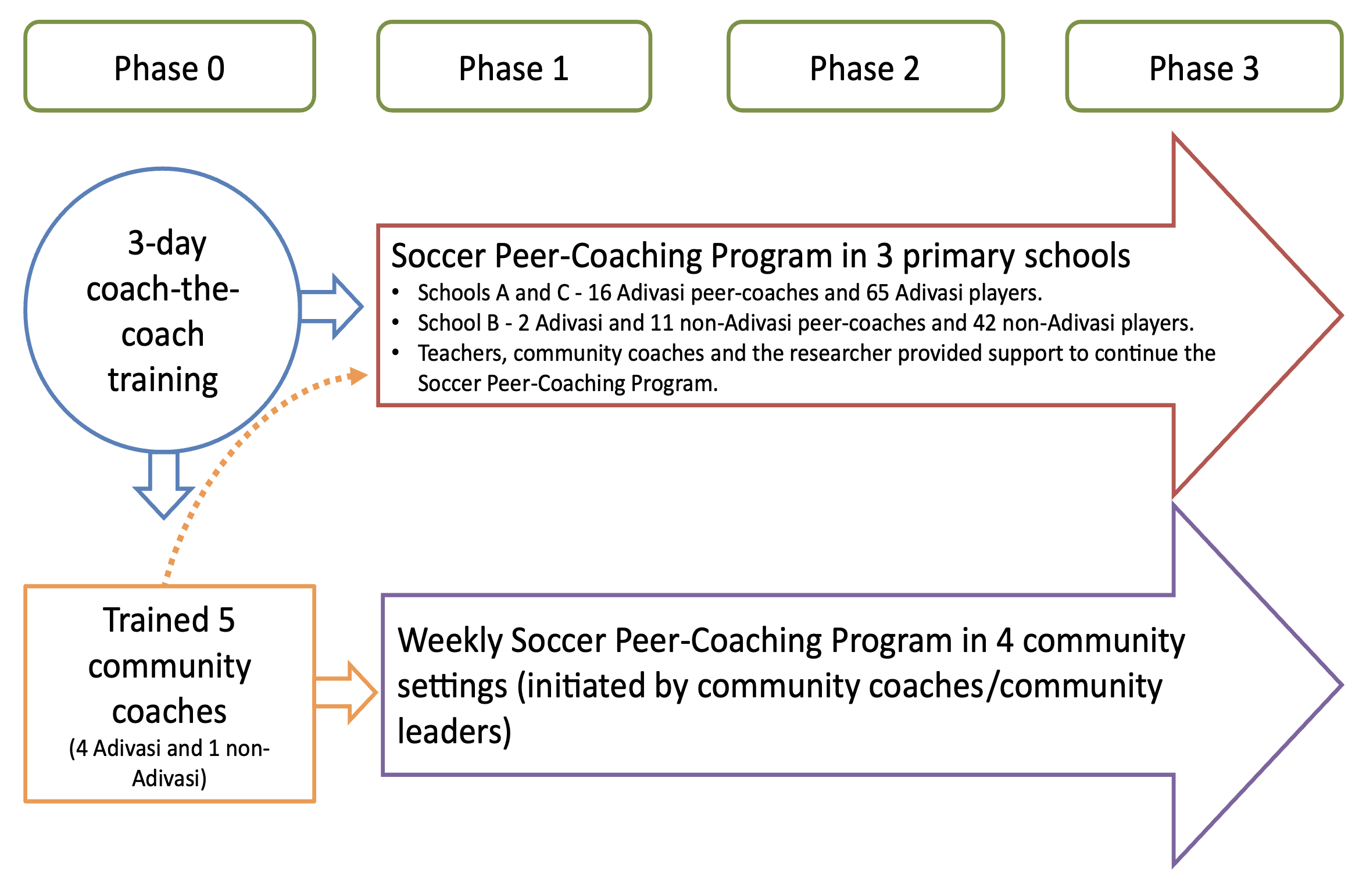
Past research acknowledges that SFD program aiming for empowerment and efficacy outcomes, must have supportive work relationships between change agents (Schulenkorf, 2012; Skinner et al., 2008). The first author and the Nilgiris-Wynaad Tribal Welfare Society had supportive work relationships to initiate the Phase 0 program. The first author is a licensed junior soccer and athletics coach in Australia, and he was responsible for the coaching delivery. Phase 0 program used two in-class (theoretical) and three outdoor (practical) sessions to transfer soccer coaching knowledge. Following this, and in consultation with the stakeholders, ongoing support was provided to peer-coaches in schools and communities. As such, SPCP implemented a systematic process in transferring soccer coaching knowledge and skills which empowered most of the community coaches to implement the soccer program in their communities (Schulenkorf, 2012; Spaaij et al., 2017).
LITERATURE REVIEW
Empowerment
Empowerment has been examined through sociological, organizational, and psychological lenses and is widely conceptualized as a process through which individuals and groups enhance their capacity to make meaningful choices and act upon them (Gutierrez, 1990; Rowlands, 1997). In this study, “action” refers specifically to soccer peer-coaches’ ability to make decisions, influence social interactions, and navigate existing power relations within their immediate social contexts (e.g., soccer coaching practices, peer interactions, and engagement with teachers and community leaders).
Power is central to empowerment and is inherently relational (Foucault, 1982). According to Rowlands (1997), power can be expressed in multiple forms: Power over (controlling power), power to (generative or productive power), power with (collective power) and power from within (spiritual or inner power). Although controlling power can have negative effects, in the process of empowerment, power is seen as gaining access to resources and increasing capacity to act. As empowerment and power are interconnected and power is relational and exists only if actioned, more research drawing clear connections between empowerment and power relationships of individuals and society are essential to set empowerment strategies for the powerless (in this case, Adivasi).
Empowerment initiatives are essential for marginalized communities such as Adivasi seeking to change their life situation (Rowlands, 1997). According to Lawson (2005), sport programs can be liberating and empowering people. Many practitioners, including indigenous NGOs successfully implemented sport-based empowerment initiatives for community development (Spaaij & Jeanes, 2012). Researchers identified that sport could facilitate access to knowledge and resources and thus increase capacity for individuals and communities to implement sport and non-sport initiatives. For example, a community-based sport program conducted among diverse ethnic groups (Roma, North African, Latin-American, Caucasian and sub-Saharan), 3 coaches, the researcher and 31 children (García López & Kirk, 2021) identified that sport could be a powerful tool for empowering children from socially vulnerable backgrounds. Based on a study conducted among 68 youngsters, aged 8 to 19 in Zambian school and community contexts, Jeanes (2013) identified that SFD initiatives can be a catalyst in empowering young people. Similarly, in the United Kingdom, an action research study by Partington and Totten (2012) demonstrated that participation in a community sport program empowered participants from low socioeconomic backgrounds to engage and negotiate with external stakeholders.
However, recent scholarship highlights the tensions, contradictions, and context-specific limitations within SFD initiatives (Raw et al., 2022; Schulenkorf & Sherry, 2021). In the Indian context, caste-based exclusion presents particular challenges for achieving inclusive outcomes through sport (Philip et al., 2022). While structured sport programs have demonstrated potential to support human resource development and psychosocial development (Philip et al., 2023; Sai & Gayatri, 2025), their impact is often contingent on how effectively they engage with entrenched social hierarchies.
These limitations point to the dynamic and context-dependent nature of empowerment, which is shaped by the interaction between individuals and their social environments (Kuokkanen & Leino‐Kilpi, 2000). In this regard, empowerment is closely linked to self-efficacy, individuals’ belief in their ability to act effectively in challenging contexts (Bandura, 1997; Heslin, 1999). While SFD practitioners often promote their initiatives as mechanisms for enhancing empowerment, past research has urged caution around such claims (Coalter & Taylor, 2010; Lawson, 2005; Schulenkorf, 2012; Spaaij et al., 2017; Welty Peachey et al., 2015). These studies suggest that although SFD initiatives may hold potential to enhance empowerment and self-efficacy dimensions, their impact is highly context-dependent and not inherently guaranteed. This raises the need for a more critical examination of how self-efficacy is understood, fostered, and experienced within the context of SFD initiatives.
Self-Efficacy
Self-Efficacy Theory, rooted in social cognitive theory, holds that belief in one’s ability to act effectively drives behavior more than rewards or punishments (Bandura, 1977). It is shaped by mastery experiences, observation, encouragement, and emotional state. Self-Efficacy Theory conceptualizes the interrelationship and interaction between the triadic factors such as person, behavior, and environment (Bandura, 1997; Rawlett, 2014; Resnick, 2014). While these triadic factors interact, their influence may vary depending on how a person perceives the environment and their ability to complete a task (Bandura, 1997; Resnick, 2014). According to Bandura (1977), “people process, weigh, and integrate diverse sources of information concerning their capability, and they regulate their choice behavior and effort expenditure accordingly” (p. 212). As the future performance of a person is based on the judgment of their past behavior, self-efficacy is not an unrealistic optimism (Bandura, 1977; Luszczynska & Schwarzer, 2015). According to Bandura (1997), self-efficacy beliefs are constructed from four principal sources of information: enactive mastery experience, vicarious experience (model behavior), verbal persuasion and physiological feedback (emotional state of a person). Therefore, strengthening these sources may result in enhanced self-efficacy beliefs (Bandura, 1997).
Individuals with strong self-efficacy are more likely to persist through challenges, and self-efficacy is crucial for achieving desired outcomes, particularly in competitive sport (Bandura, 1997; Feltz et al., 2008). Although SFD programs are said to enhance self-efficacy, supporting research remains limited (Coalter & Taylor, 2010; Lawson, 2005; Schulenkorf, 2012; Spaaij et al., 2017; Welty Peachey et al., 2015). For example, based on multiple studies conducted to examine the impacts of a SFD event, Welty Peachey et al. (2015) identified that educational elements of SFD in an intergroup setting can increase participants’ self-efficacy. Similarly, based on evaluations of SFD programs conducted in India, South Africa, Tanzania, Uganda, Coalter and Taylor (2010) acknowledged the general tendency of SFD programs in improving self-efficacy among participants; however, raised concerns about the rigor of the data.
In summary, existing SFD research offers limited evidence on how self-efficacy is effectively developed through such programs, and none have explored its impact within a caste-based social context. Therefore, a longitudinal SPCP was implemented to examine the micro-level impacts of empowerment and self-efficacy among Adivasi participants. A micro-level approach enables context-specific insights beyond broad generalizations. Given that productive relationships among SFD stakeholders enhance motivation and efficacy (Schulenkorf, 2012), this study employed an action research methodology to foster such relationships and support meaningful outcomes (Meir, 2017).
METHODOLOGY
This study employed interpretive qualitative action research to collaboratively design and implement a culturally relevant SFD program. This approach enabled context-specific analysis and fostered critical reflection among participants and researchers.
Action research methodology also enabled the development of supportive relationships between the researcher and participants (McNiff & Whitehead, 2011; Meir, 2017; Ritchie, 1996; Spaaij et al., 2017). Supportive relationships were essential to design, implement and evaluate the SPCP and to collect data from different stakeholders and conduct a micro-level analysis to identify the self-efficacy and empowerment impacts of the SPCP. Existing research suggests that supportive relationships play a key role in the development of self-efficacy (Werner, 1994). Moreover, as empowerment is an ongoing and relational process, action research provides a framework for fostering partnerships and developing critical consciousness through cycles of reflection and action (Ritchie, 1996). Given the study’s focus on vulnerable groups and the complex, relational processes required to implement the SPCP, a qualitative action research approach was considered most appropriate (Kay, 2009; Liamputtong, 2007).
This research was conducted in a culturally diverse rural context and involving Adivasi participants. To ensure cultural relevance and community engagement, the authors established a partnership with Nilgiris-Wynaad Tribal Welfare Society, a non-government organization which was established in 1979 to support Adivasi people living in Pandalur Taluk, The Nilgiris (NWTWS, 2012). A Soccer Committee, consisting of eight community leaders (four Adivasi and four non-Adivasi) and the first author, was also formed to govern and lead the project. The first author is of Indian origin and has cultural knowledge and local language proficiency. Although he doesn’t practice caste system, holds implicit high-power social status among the partners as he is educated and well-connected non-Adivasi.
The productive relationship developed through the partnership was instrumental in recruiting both individual and institutional stakeholders to the project. It also enabled a nuanced cultural understanding of the power relationships between Adivasi and non-Adivasi communities, which informed the initiation of the SFD program. Soccer was identified as the favorite sport among Adivasi men; Adivasi women traditionally participated in singing and dancing (Philip et al., 2022). Therefore, with the intention of establishing a sustainable (Sherry & Schulenkorf, 2016; Spaaij, 2012) and a culturally acceptable (MacIntosh et al., 2016) SFD program, both sport and non-sport components were included.
Data Collection
Action research was ideal for collecting data on empowerment and self-efficacy in rural Indian settings because it enables the development of context-specific measures that reflect the lived realities and situational demands of participants. It allowed the individual and institutional program participants and the researcher to work together to collect the data for this study. As shown in Table 1, data were collected from multiple sources: observations captured participant and researcher perspectives, while interviews gathered insights from peer-coaches, teachers and community leaders regarding the program’s impact enabled answering the research question.
Table 1 – Summary of Data Collection Methods Across Phases
| Methods | Phase 0 | Phase 1 | Phase 2 | Phase 3 | Total | ||||||
| Residential | A | B | C | A | B | C | A | B | C | ||
| Observation | 2 | 1 | 1 | 1 | 1 | 1 | 1 | 1 | 1 | 1 | 11 |
| Focus Group Observation | 0 | 3 | 3 | 3 | 3 | 3 | 3 | 3 | 3 | 3 | 27 |
| Semi-Structured Interview | 0 | 8 | 7 | 8 | 1 | 2 | 1 | 4 | 8 | 4 | 43 |
This study received ethics approval from the researcher’s institution, with additional oversight of ethical, governance, and leadership matters provided by the Soccer Committee at the local level. Formal agreements were established with the Nilgiris-Wynaad Tribal Welfare Society and participating schools, through which participants were recruited. Participant Information Statements were provided in Tamil or English based on preference, and schools facilitated interactive sessions with parents and participants before obtaining written consent. Student coaches, were recruited through open invitations within their respective schools.
The cultural knowledge and language abilities enabled the first author to work with stakeholders and collect the data in four phases over a period of 24 months. Data collected in Phases 0, 1 and 2 were analyzed by the Soccer Committee to make incremental changes in SPCP in subsequent phases. Therefore, drawing on the action research methodology, the research was fed back into the program. Methods such as observation (11 observations: two observation sessions in two days during Phase 0 and 9 observation sessions in three schools – one observation each in Phases 1, 2 and 3) and focus group observation (27 group observation sessions in three schools – three observations each in Phases 1, 2 and 3) were conducted to collect data from 54 Adivasi and 33 non-Adivasi student peer-coaches (aged 10 to 15 years) and 43 (21 Adivasi and 22 non-Adivasi) semi-structured interviews from community coaches/leaders/school teachers (aged 18 years and over). Drawing on action research methodology, the data were collected through both participatory and non-participatory observations. Interviews and observations, each lasting 15 to 30 minutes, form the basis of the dataset for this paper. By collecting data in multiple phases, locations and people, this study uses data triangulation (Kimchi et al., 1991).
The cultural, social and educational competencies of the participants were different (Philip et al., 2022). Moreover, they were multilingual; therefore, the semi-structured interview method allowed the researcher to seek clarity by re-wording or re-ordering the questions (Tong et al., 2007). The participative and non-participative observations enabled the researcher to participate in SPCP and conduct the action research. Notes, video and audio recordings were used to collect the data. Unlike generalized measurement tools, action research allows for tailored, context-specific inquiry essential for generating relevant insights in culturally and socially nuanced settings (Bandura, 2006).
The data collection methods used in this study were well-suited to its aims and context. Given the study’s diverse context and participant backgrounds, interviews, observations, and focus groups were deemed more effective than standardized self-efficacy scales for capturing rich, meaningful data. The focus was on peer-coaches’ ability to execute the coaching program effectively. Although most were current or former soccer players, none had prior coaching experience, and their pre-intervention self-efficacy was generally low. This made it essential to assess how their confidence and skills developed through the SPCP. Self-efficacy was measured by evaluating their capacity to plan and deliver coaching sessions in schools and communities’ post-intervention. Interview and focus group questions, along with direct observations, were designed to capture either the peer-coaches’ self-assessed competence or observable evidence of successful task completion, ensuring the approach was both practical and contextually grounded.
Data Analysis
As the research context was multilingual, the interviews and observations were in local languages (Tamil and Malayalam) or in English, and in some cases, a mix of local and English languages. The video and audio recordings in English were transcribed, and non-English data were translated and transcribed verbatim by the first author. The transcripts were then imported into NVivo 10 and analyzed using a thematic analysis approach, involving systematic coding, theme development, and refinement of themes, and were organized into categories and sub-categories (initial and axial coding; Liamputtong, 2013). The data was shared among researchers to independently examine both initial and axial coding stages for prudency. An inductive approach was adopted for data analysis. Abbreviations were assigned during the initial coding for common themes and patterns such as ideas, concepts, terminologies and phrases in the process; research team used reasoning and rationalization process to address any difference of opinion, then axial coding was used to connect the themes (DeCuir-Gunby et al., 2011; Minichiello et al., 2008).
RESULTS AND DISCUSSION
Thematic analysis of the observations, focus group observations and interviews identified two interrelated themes that explain the dynamics of the interactions between study participants and the impact of the SFD program on peer-coaches: Empowerment and Self-Efficacy. These themes are grounded in participants’ lived experiences and are used here as analytical lenses to interpret how caste-based power relations shape program outcomes. Importantly, these themes are not only reflective of individual experiences but are also embedded within broader socio-cultural structures, necessitating analysis across both micro-and-macro – levels.
Empowerment
‘Empowerment’ here refers to increased personal and organizational capacity to perform as a coach through the acquisition of coaching knowledge, equipment and opportunity. The program effectively provided knowledge, equipment, and confidence to peer-coaches, enabling them to lead sessions in schools and communities.
“This is a huge exposure…for our children. The accessories they are using (bib, boot, cones, small goals) … Football for us was going to a ground and just play with one ball but this program taught us many novel ideas of coaching” (Phase 3 – Interview 3).
A community coach also stated that SPCP was able to improve their soccer skills and empower them to get invited to play for the local community club to represent the club in the inter-club soccer competitions:
“We go and play club football, previously we just played without knowing how to play but now our game has improved… Since our skills are improved, the local club (Ambedkar Club) uses our paddy kids to play for their club” (Phase 2 – Interviewee 2).
The last day of the Phase 0 session a community meeting was organized by the Nilgiris-Wynaad Tribal Welfare Society to formally thank the participants. “The community coaches were also awarded grass roots soccer coaching certificates issued by Sport4all Foundation Inc. and were also provided some basic playing equipment” (Phase 0 – Observation). The certificates were awarded for the community coaches to commission and promote them to be a soccer coach. Recognizing people or swearing-in during a community meeting is an accepted way of formalizing power and authority at the location of this study.
Soccer coaching knowledge and equipment enabled the student coaches in schools to conduct coaching sessions for juniors. “It was observed that student coaches were able to conduct coaching sessions for juniors” (Phase 2 – Observation 1). The peer-coaching experiences shifted the student coaches’ mindset with the realization that they had skills to impart to others; and they came to believe that children and youths can also be coaches. School B student coaches said that: “Adults used to teach us, but now this program is giving us the opportunity to coach” (Phase 1 – Focus Group 1).
The peer-coaching experience gained through school coaching opened the possibility of success not only as a player and a coach but also in other parts of life. A group of student coaches at School A stated that:
“We want to play well and go to other places and play and become popular. I would like to be a good coach like our coaches [community coaches] and would like to achieve things in my life” (Phase 1 – Focus Group 3).
In addition to conducting coaching program in their own school, “[School A] student coaches initiated coaching sessions in a primary school [attended by Adivasi and non-Adivasi students] not participated in this study” (Phase 2 – Interviewee 7). The above discussions demonstrate how the process of soccer coaching and training instilled individual capacity and efficacy (Kuokkanen & Leino‐Kilpi, 2000; Lawson, 2005). Therefore, we agree with past SFD researchers that SFD programs can be a useful tool to empower participants (García López & Kirk, 2021; Jeanes, 2013; Partington & Totten, 2012). The coaches demonstrated increased power to (Rowlands, 1997), reflected in their ability to act independently and assume leadership roles.
However, empowerment was not without limitations. Student coaches encountered practical challenges in delivering sessions, often requiring support from teachers or community coaches: “a physically challenged student…didn’t follow the rules” (Phase 1 – Observation 4). In these instances, support was sought from teachers: “student coaches sought the teacher’s help. The teacher resolved the issue” (Phase 1 – Observation 4). The collaborative support of teachers and community coaches proved beneficial, enhancing the effectiveness of student coaching efforts: “With the support of community coaches and myself [researcher], the student coaches managed to gather the players” (Phase 1 – Observation 1). This highlights the importance of collaborative and supportive environments in sustaining empowerment outcomes.
The community coaches worked together to establish a soccer league at Ambalamoola to conduct soccer matches. The coaching program also encouraged the participants to make their own equipment such as soccer goals. “Coaches were empowered and were able to construct small goals using materials available locally for their training; small goals had been introduced to the coaches through the soccer program” (Phase 3 – Interviewee 11).
A Soccer Committee was also formed to provide visionary leadership to make improvements and sustain the SPCP. This opportunity empowered the members to assess the true state of Adivasi community’s social network opportunities and set the vision for SPCP to deliver more activities to improve intergroup interaction. For example, an Adivasi elder who is also a Soccer Committee member said that:
“Now, Adivasi is like a frog in the pond, we only know the pond and what is inside the pond. This program helping the children to go beyond the pond and have interaction with the actors there. There are different program running for Adivasi and it is supporting them in their growth, but that is all within their community. There are very few programs helping them to integrate outside Adivasi community. I foresee that this soccer program helps Adivasi to integrate with non-Adivasi groups” (Phase 2 – Interviewee 6)
The above data indicate that the coach education and accreditation components of the SPCP played a significant role in developing both personal and organizational capacity among participants. Through access to structured training, resources, and formal recognition, peer-coaches enhanced their individual capabilities (Gutierrez, 1990) and demonstrated greater independence in initiating and delivering coaching activities (Mainiero, 1986). This was reflected in their ability to organize and lead sessions autonomously, extend activities beyond the formal program, and, in community contexts, establish local leagues and develop improvised resources. These outcomes signal a shift toward increased agency, consistent with the development of power to and power from within (Rowlands, 1997).
However, these gains must be interpreted within the broader socio-cultural context in which the program operates. In this case, caste-based hierarchies shape and regulate access to opportunity, authority, and social interaction. While the SPCP enhanced participants’ capacity to act, the extent to which this capacity could be exercised was uneven across contexts. This suggests that empowerment at the micro-level is mediated, and at times, constrained by entrenched social relations and structural inequalities.
Furthermore, empowerment was not without limitations. Student coaches encountered practical challenges in delivering sessions, often requiring support from teachers or community coaches. The collaborative support of teachers and community coaches proved beneficial, underscoring the importance of supportive environments in sustaining empowerment outcomes.
Taken together, these findings suggest that while SFD programs can effectively build individual and organizational capacity, empowerment should not be understood as an automatic or linear outcome. Rather, it is a context-dependent and relational process shaped by the interaction between individual capabilities and broader structural conditions.
Self-Efficacy
Peer-coaches demonstrated empowerment through increased self-belief and successful program delivery. Notably, one Adivasi coach was able to train players of higher social status, reflecting confidence gains. However, none of the other three Adivasi community coaches were able or willing to coach non-Adivasi players. A community coach, who was also instrumental in establishing the community coaching and soccer league did not show readiness to train non-Adivasi people. In response to the first author’s suggestion to include non-Adivasi players in coaching, he replied that he was not comfortable to train players from non-Adivasi backgrounds:
He shook his head in disagreement and said, it is not right, Sir. It doesn’t work. As if, he was not ready to challenge the present social system or unsure of any social consequences that may cause because an Adivasi shows interest in coaching non-Adivasi [mostly, higher in the caste system than Adivasi]. (Phase 3 – Observation 5)
Although the Adivasi participants were empowered through SPCP, in intergroup (Adivasi and non-Adivasi) community contexts, most of the community coaches (Adivasi) were unable to believe that they had the necessary capability to successfully implement the soccer coaching program. Therefore, we construe that caste-based systemic oppression (Philip et al., 2022) existed in India nullified the self-efficacy beliefs gained through the SPCP. Although participants developed confidence through coaching experiences, their belief in their ability to act was context-dependent and shaped by perceived social risks. An Adivasi elder also highlighted the role of contextual constraints: “Adivasi people are interested in sport. They have individual capabilities and physicality to do better in activities such as sport. But their social growth is restricted by their life situation and the society” (Phase 2 – Interviewee 6).
It was also observed that “two of the Adivasi student coaches [School B] had the opportunity to coach children from non-Adivasi background. However, the coaches struggled to establish eye contact with players.” (Phase 2 – Observation 1). Similarly, a student coach from School C deliberately avoided the combined coaching session noting that he was afraid to attend a coaching session with non-Adivasi students “I asked him why he did not attend the combined soccer coaching session…He replied ‘pediya’ [scared]. Who are you scared of… [non-Adivasi students] he replied.”(Phase 2 – Observation 5).
Adivasi student coaches who had attended the combined coaching session also commented that they were nervous at the start of the session. When I asked them to share their views on the combined coaching session, the student coaches responded that “we were scared at the beginning. But after some time, we were comfortable” (Phase 2 – Focus Group 1).This clearly indicate that the presence of non-Adivasi students can cause discomfort for some Adivasi students; thus, in inter-caste context, educational components alone were insufficient to foster self-efficacy (Welty Peachey et al., 2015). However, student coaches had support and encouragement from teachers, community coaches and school authorities to conduct the coaching sessions. Past studies show that supportive relationship had positive correlation to self-efficacy and empowerment (Benson et al., 2012; Werner, 1994). Moreover, teachers or community leaders were physically present during the soccer coaching at schools; and therefore, student coaches were able to conduct coaching for mixed groups. “Itwas interesting to note that the teacher’s presence itself is helping the players to be more focused and create an equitable environment” (Phase 1 – Observation 3). The above results indicate that contextual factors influence Empowerment and Self-Efficacy dimensions in a SFD program.
The data clearly indicate that student coaches from Adivasi backgrounds struggled to conduct intergroup coaching in the earlier stages of the SPCP; however, supportive environment, teachers being present and providing encouraging feedback enabled those coaches to conduct coaching. Therefore, in this context, it is not just the opportunities for facilitation and participation of a sport that empowered the student coaches (Wilson et al., 2006), it is the supportive environment for inclusive social development (Kunz, 2009) that provides the inner power (Rowlands, 1997) and self-efficacy (Bandura, 1997; Maddux & Stanley, 1986) for student peer-coaches to successfully implement the coaching. Therefore, the authors argue that a supportive environment can act as an empowerment enabler in challenging intergroup settings to gain self-efficacy for individuals to perform effectively.
The above finding extends the current understanding of empowerment and self-efficacy linkages. Past research identified empowerment as a positive process (Kuokkanen & Leino‐Kilpi, 2000; Lawson, 2005) of transferring power and decision making authority (Heslin, 1999; Özaralli, 2003) to reduce dependency (Mainiero, 1986). Within this literature, empowerment is often assumed to lead linearly to action once resources, authority, and opportunities are provided.
This study demonstrates that knowledge, resources and opportunities (Gutierrez, 1990; Heslin, 1999; Wood et al., 2019) may not necessarily translate into enacted empowerment for individuals from low-power social groups. Internal resistance due to societal or cultural factors, in this case, caste-based systemic oppression for generations (Philip et al., 2022) inhibits empowerment initiatives in intergroup settings.
However, the micro-level analysis using Self-Efficacy Theory in this study identified that supportive environment and inclusive social relationships in SFD program delivery has the potential to mitigate the internal resistance and positively influence participants’ capability and self-efficacy (Bandura, 1977, 1997; Maddux & Stanley, 1986). In this case, verbal persuasion and physiological feedback (Bandura, 1997), teachers, researcher, and community coaches being physically present and providing a supportive environment were significant sources of information that enabled the coaches to construct positive self-efficacy. This represents an important theoretical contribution of the study.
Taken together, these findings suggest that self-efficacy, like empowerment, is not an automatic outcome of skill development but is a context-dependent and relational process. In contexts marked by entrenched hierarchies, individuals may demonstrate competence in familiar environments while remaining hesitant to enact these capabilities in socially stratified settings. This highlights that the development of “power from within” (Rowlands, 1997) must be supported by enabling social conditions to be effectively translated into action.
Importantly, differences emerged between school and community contexts. In school settings, structured support, institutional authority, and the presence of teachers appeared to reduce the perceived social risks associated with intergroup interaction, enabling student coaches to enact their self-efficacy. In contrast, community settings, while offering greater autonomy, exposed participants more directly to entrenched social hierarchies, limiting the expression of self-efficacy.
Overall, these findings extend existing theory by linking micro-level processes with macro-level socio-cultural structures, demonstrating that empowerment and self-efficacy are not solely products of individual capacity-building but are co-constructed within and constrained by broader social systems.
CONCLUSION
This micro-level analysis of a SFD program demonstrates that while peer-coaches developed skills, resources, and opportunities to deliver soccer training, the development and enactment of self-efficacy were uneven across contexts. Participants exhibited confidence in familiar and socially homogeneous settings; however, most Adivasi community coaches were reluctant to extend their roles into inter-caste environments. This indicates that increased capacity “power to” (Rowlands, 1997) does not necessarily translate into perceived capability to act, revealing a critical gap between empowerment and self-efficacy in practice.
Caste-based dynamics limited the self-efficacy for Adivasi community coaches in intergroup contexts. The caste-based unequal power relationships existed in the society had a negative influence on the self-efficacy expectations of Adivasi community coaches, who had considerably low-power comparing to non-Adivasi; and they doubted their capability (Bandura, 1977, 1997; Maddux & Stanley, 1986) to conduct intergroup coaching sessions. There was no evidence of any external resistance that impacted these community coaches’ self-efficacy beliefs. Therefore, we argue that it was the internal resistance due to systemic oppression existed in the society (Philip et al., 2022) negatively influenced their self-efficacy expectancy which refrained them from initiating intergroup coaching sessions. In this case, soccer coaching knowledge, equipment and expertise (Gutierrez, 1990; Wood et al., 2019) were not sufficient for those coaches to feel powerful to conduct coaching in intergroup contexts.
Despite these contextual influences in the community, we found that the student coaches were able to conduct intergroup coaching sessions in schools. This reflects important contextual differences between school and community environments. Community-based coaching was intentionally designed to be organic and flexible, enabling peer-coaches to develop autonomy, ownership, and leadership through self-directed practice. In contrast, school-based coaching was supported by sustained institutional involvement, including teachers, the researcher, and community leaders, creating a more structured and supportive environment for implementation.
This distinction does not suggest that school-based SFD is inherently more effective than community-based approaches. Rather, it demonstrates how different contextual conditions shape the extent to which empowerment and self-efficacy can be enacted. In school settings, structured support and institutional authority reduced perceived social risks associated with intergroup interaction, enabling participants to translate confidence into action. In contrast, community settings exposed participants more directly to entrenched social hierarchies, limiting the expression of self-efficacy despite greater autonomy.
These findings highlight that opportunities for sport participation and skill development alone are not sufficient to produce sustained behavioral change in contexts marked by structural inequality. Instead, supportive social environments are essential in bridging the gap between empowerment (“power to”) and self-efficacy (“power from within”). Such environments, characterized by trust, legitimacy, and relational support, enable individuals and groups to enact their capabilities, particularly in socially stratified settings.
The study offers important implications for both research and practice. For practitioners, it suggests that SFD programs operating in contexts of structural inequality must move beyond a sole focus on skill development and incorporate deliberate strategies to create supportive and socially safe environments, particularly in intergroup settings. This may include the involvement of trusted authority figures, structured facilitation, and gradual exposure to cross-group interaction. For researchers, the findings underscore the importance of integrating micro-level constructs, such as self-efficacy, with macro-level analyses of power and inequality. Future SFD research should therefore adopt multi-level frameworks that account for how structural conditions enable or constrain individual agency.
Although caste-based oppression is India-specific, the findings have wider implications for programs in settings marked by systemic inequality, including those structured by race, ethnicity, and other forms of social stratification. Across such contexts, empowerment initiatives must attend not only to individual capacity-building but also to the social and institutional conditions that enable or constrain action. Creating supportive environments is therefore essential for enabling meaningful participation, leadership, and intergroup engagement.
A limitation of this study is its rural focus, involving only three schools and community settings within a single geographic area. Future research should expand to urban and metropolitan contexts, incorporating multiple schools and communities to enable a broader and more nuanced understanding of the factors influencing empowerment and self-efficacy across diverse groups.
Overall, this study demonstrates that while SFD programs can foster empowerment and self-efficacy, their effectiveness is contingent upon the interaction between individual capacities and broader socio-structural conditions. Addressing these structural dimensions is essential for enabling meaningful, sustained, and inclusive social change.
CONFLICT OF INTEREST
The authors have no known competing financial or non-financial interests that could have appeared to influence the work reported in this paper.
FUNDING STATEMENT
The authors received no financial support for the authorship, and/or publications of this article.
REFERENCES
Annett, E., & Darby, P. (2024). Interpreting and enacting ‘empowerment’ in sport for development: the perspectives of UK stakeholders on a partnership-based programme in Malawi. Sport in Society, 1-19. https://doi.org/10.1080/17430437.2024.2382192
Bandura, A. (1977). Self-efficacy: Toward a unifying theory of behavioral change. Psychological Review, 84(2), 191-215. https://doi.org/10.1037/0033-295X.84.2.191
Bandura, A. (1997). Self-efficacy: The exercise of control. W.H. Freeman and Company.
Bandura, A. (2006). Guide for constructing self-efficacy scales. In F. Pajares & T. Urdan (Eds.), Self-efficacy beliefs of adolescents (pp. 307-337). Information Age Publishing.
Bates, T. R. (1975). Gramsci and the Theory of Hegemony. Journal of the History of Ideas, 36(2), 351-366. https://doi.org/10.2307/2708933
Benson, P. L., Leffert, N., Scales, P. C., & Blyth, D. A. (2012). Beyond the “village” rhetoric: Creating healthy communities for children and adolescents. Applied Developmental Science, 16(1), 3-23. https://doi.org/10.1080/1088
Bros, C. (2014). The burden of caste on social identity in India. The Journal of Development Studies, 50(10), 1411-1429. https://doi.org/10.1080/00220388.2014.940908
Burnett, C. (2001). Social impact assessment and sport development: Social spin-offs of the Australia-South Africa junior sport programme. International Review for the Sociology of Sport, 36(1), 41-57. https://doi.org/10.1177/101269001036001005
Chawansky, M., & Mitra, P. (2015). Family matters: studying the role of the family through the eyes of girls in an SfD programme in Delhi. Sport in Society, 18(8), 983-994. https://doi.org/10.1080/17430437.2014.997577
Coalter, F. (2007). A wider social role of sport: Who’s keeping the score? Routledge.
Coalter, F., & Taylor, J. (2010). Sport-for-development impact study. A research initiative funded by Comic Relief and UK Sport and managed by International Development through Sport. University of Stirling.
DeCuir-Gunby, J. T., Marshall, P. L., & McCulloch, A. W. (2011). Developing and using a codebook for the analysis of interview data: An example from a professional development research project. Field Methods, 23(2), 136-155. https://doi.org/10.1177/1525822X10388468
Feltz, D. L., Short, S. E., & Sullivan, P. J. (2008). Self-efficacy in sport. Human Kinetics.
Forde, S. D., & Frisby, W. (2015). Just be empowered: How girls are represented in a sport for development and peace HIV/AIDS prevention manual. Sport in Society, 18(8), 882-894. https://doi.org/10.1080/17430437.2014.997579
Foucault, M. (1982). The subject and power. Critical inquiry, 8(4), 777-795. https://doi.org/10.1086/448181
García López, L. M., & Kirk, D. (2021). Empowering children from socially vulnerable backgrounds through the use of roles in sport education. Sport, Education and Society, 27(6), 676-688. https://doi.org/10.1080/13573322.2021.1897563
Gutierrez, L. M. (1990). Working with women of color: An empowerment perspective. Social Work, 35(2), 149-153. https://doi.org/10.1093/sw/35.2.149
Hardy, C., & Leiba-O’Sullivan, S. (1998). The power behind empowerment: Implications for research and practice. Human Relations, 51(4), 451-483. https://doi.org/10.1177/001872679805100402
Heslin, P. A. (1999). Boosting empowerment by developing self‐efficacy. Asia Pacific Journal of Human Resources,37(1), 52-64. https://doi.org/10.1177/103841119903700105
Jeanes, R. (2013). Educating through sport? Examining HIV/AIDS education and sport-for-development through the perspectives of Zambian young people. Sport, Education and Society, 18(3), 388-406. https://doi.org/10.1080/13573322.2011.579093
Jeanes, R., & Kay, T. (2010). Editor’s Introduction: Developing through sport and leisure? Critical perspectives from the international development context. LSA Newsletter, 85, 31-33.
Kanter, R. M. (1979). Power failure in management circuits. Harvard Business Review, 4, 65-75.
Kay, T. (2009). Developing through sport: Evidencing sport impacts on young people. Sport in Society, 12(9), 1177-1191. https://doi.org/10.1080/17430430903137837
Kidd, B. (2008). A new social movement: Sport for development and peace. Sport in Society, 11(4), 370-380. https://doi.org/10.1080/17430430802019268
Kimchi, J., Polivka, B., & Stevenson, J. S. (1991). Triangulation: Operational definitions. Nursing Research, 40(6), 364-366. https://doi.org/10.1097/00006199-199111000-00009
Kunz, V. (2009). Sport as a post-disaster psychosocial intervention in Bam, Iran. Sport in Society, 12(9), 1147-1157. https://doi.org/10.1080/17430430903137803
Kuokkanen, L., & Leino‐Kilpi, H. (2000). Power and empowerment in nursing: Three theoretical approaches. Journal of Advanced Nursing, 31(1), 235-241. https://doi.org/10.1046/j.1365-2648.2000.01241.x
Lawson, H. A. (2005). Empowering people, facilitating community development, and contributing to sustainable development: The social work of sport, exercise, and physical education programs. Sport, Education and Society,10(1), 135-160. https://doi.org/10.1080/1357332052000308800
Liamputtong, P. (2007). Researching the Vulnerable. Sage.
Liamputtong, P. (2013). Qualitative research methods (4th ed.). Oxford University Press.
Luszczynska, A., & Schwarzer, R. (2015). Social cognitive theory. In M. Conner & P. Norman (Eds.), Predicting and changing health behaviour: Research and practice with social cognition models (2nd ed., pp. 127-169). Open University Press.
Lyras, A., & Welty Peachey, J. (2011). Integrating sport-for-development theory and praxis. Sport Management Review,14(4), 311-326. https://doi.org/10.1016/j.smr.2011.05.006
MacIntosh, E., Arellano, A., & Forneris, T. (2016). Exploring the community and external-agency partnership in sport-for-development programming. European Sport Management Quarterly, 16(1), 38-57. https://doi.org/10.1080/16184742.2015.1092564
Maddux, J. E., & Stanley, M. A. (1986). Self-efficacy theory in contemporary psychology: An overview. Journal of Social and Clinical Psychology, 4(3), 249-255. https://doi.org/10.1521/jscp.1986.4.3.249
Mainiero, L. A. (1986). Coping with powerlessness: The relationship of gender and job dependency to empowerment-strategy usage. Administrative Science Quarterly, 31(4), 633-653. https://doi.org/10.2307/2392967
McNiff, J., & Whitehead, J. (2011). All you need to know about action research (2nd ed.). Sage Publications.
Meir, D. (2017). Leadership and empowerment through sport”: The intentions, hopes, ambitions and reality of creating a sport-for-development organisation in Cape Town. Journal of Sport for Development, 5(8), 19-29.
Minichiello, V., Aroni, R., & Hays, T. N. (2008). In-depth interviewing: Principles, techniques, analysis (3rd ed.). Pearson Education Australia.
Natrajan, B. (2022). Racialization and ethnicization: Hindutva hegemony and caste. Ethnic and Racial Studies, 45(2), 298-318. https://doi.org/10.1080/01419870.2021.1951318
NWTWS. (2012). Chronicle. http://www.nwtws.org/history2.html#top
Özaralli, N. (2003). Effects of transformational leadership on empowerment and team effectiveness. Leadership & Organization Development Journal, 24(6), 335-344. https://doi.org/10.1108/01437730310494301
Partington, J., & Totten, M. (2012). Community sports projects and effective community empowerment: a case study in Rochdale. Managing Leisure, 17(1), 29-46. https://doi.org/10.1080/13606719.2011.638205
Philip, B., Hoye, R., & Sherry, E. (2022). Sport-for-development and social inclusion in caste-ridden India: Opportunities and challenges. Soccer & Society, 23(8), 970-986. https://doi.org/10.1080/14660970.2021.1993199
Philip, B., Seal, E. L., & Philip, S, (2023). Human resource development for community development: Lessons from a sport‐for‐development program in rural India. Asia Pacific Journal of Human Resources, 61(2), 442-461. https://doi.org/10.1111/1744-7941.12357
Raw, K., Sherry, E., & Schulenkorf, N. (2022). Managing sport for development: An investigation of tensions and paradox. Sport Management Review, 25(1), 134-161. https://doi.org/10.1016/j.smr.2020.09.002
Rawlett, K. E. (2014). Journey from self-efficacy to empowerment. Health Care, 2(1), 1-9. https://doi.org/10.12966/hc.02.01.2014
Resnick, B. (2014). Theory of self-efficacy. In M. J. Smith & P. R. Liehr (Eds.), Middle range theory for nursing (3rd ed., pp. 199-224). Springer Publishing Company.
Ritchie, J. E. (Ed.). (1996). Using participatory research to enhance health in the work setting: an Australian experience. National Progressive Primary Health Care Network.
Rowlands, J. (1997). Questioning empowerment: Working with women in Honduras. Oxfam.
Sai, M. M., & Gayatri, K. V. A. (2025). Community empowerment through structured sports programs to support mental and emotional health in India. Help: Journal of Community Service, 2(1), 1-11. https://doi.org/10.62569/hjcs.v2i1.133
Schulenkorf, N. (2012). Sustainable community development through sport and events: A conceptual framework for Sport-for-Development projects. Sport Management Review, 15(1), 1-12. https://doi.org/10.1016/j.smr.2011.06.001
Schulenkorf, N., & Sherry, E. (2021). Applying intergroup contact theory to sport-for-development. Sport Management Review, 24(2), 250-270. https://doi.org/10.1016/j.smr.2020.08.004
Schulenkorf, N., & Sugden, J. (2011). Sport for Development and Peace in divided societies: Cooperating for inter-community empowerment in Israel. European Journal for Sport and Society, 8(4), 235-256. https://doi.org/10.1080/16138171.2011.11687881
Seal, E., & Sherry, E. (2018). Exploring empowerment and gender relations in a sport for development program in Papua New Guinea. Sociology of Sport Journal, 35(3), 247-257. https://doi.org/10.1123/ssj.2017-0166
Sherry, E., & Schulenkorf, N. (2016). League Bilong Laif: rugby, education and sport-for-development partnerships in Papua New Guinea. Sport, Education and Society, 21(4), 513-530. https://doi.org/10.1080/13573322.2015.1112780
Skinner, J., Zakus, D. H., & Cowell, J. (2008). Development through sport: Building social capital in disadvantaged communities. Sport Management Review, 11(3), 253-275. https://doi.org/10.1016/S1441-3523(08)70112-8
Spaaij, R. (2012). Beyond the playing field: Experiences of sport, social capital, and integration among Somalis in Australia. Ethnic and Racial Studies, 35(9), 1519-1538. http://dx.doi.org/10.1080/01419870.2011.592205
Spaaij, R., & Jeanes, R. (2012). Education for social change? A Freirean critique of sport for development and peace. Physical Education and Sport Pedagogy, 18(4), 442-457. https://doi.org/10.1080/17408989.2012.690378
Spaaij, R., & Schaillée, H. (2021). Inside the black box: A micro-sociological analysis of sport for development. International Review for the Sociology of Sport, 56(2), 151-169. https://doi.org/10.1177/1012690220902671
Spaaij, R., Schulenkorf, N., Jeanes, R., & Oxford, S. (2017). Participatory research in sport-for-development: Complexities, experiences and (missed) opportunities. Sport Management Review, 21(1), 25-37. https://doi.org/10.1016/j.smr.2017.05.003
Sugden, J. (2010). Critical left-realism and sport interventions in divided societies. International Review for the Sociology of Sport, 45(3), 258-272. https://doi.org/10.1177/1012690210374525
Tong, A., Sainsbury, P., & Craig, J. (2007). Consolidated criteria for reporting qualitative research (COREQ): A 32-item checklist for interviews and focus groups. International Journal for Quality in Health Care, 19(6), 349-357. https://doi.org/10.1093/intqhc/mzm042
Wagstaff, M., & Parker, A. (2020). Youth,“waithood,” and social change: Sport, mentoring, and empowerment in Sub-Saharan Africa. Journal of Sport for Development, 9(1), 1-14.
Welty Peachey, J., Cunningham, G. B., Lyras, A., Cohen, A., & Bruening, J. (2015). The influence of a sport-for-peace event on prejudice and change agent self-efficacy. Journal of Sport Management, 29(3), 229-244. https://doi.org/10.1123/jsm.2013-0251
Werner, E. E. (1994). Overcoming the odds. Journal of Developmental & Behavioral Pediatrics, 15(2), 131-136. https://doi.org/10.1097/00004703-199404000-00012
Wilson, N., Minkler, M., Dasho, S., Carrillo, R., Wallerstein, N., & Garcia, D. (2006). Training students as facilitators in the Youth Empowerment Strategies (YES!) Project. Journal of Community Practice, 14(1-2), 201-217. https://doi.org/10.1300/J125v14n01_12
Wood, J. M., Zeffane, R., Fromholtz, M., Wiesner, R., Morrison, R., Factor, A., & McKeown, T. (2019). Organisational behaviour: Core concepts and applications (5th ed.). John Wiley & Sons Australia.

