Tampere University, Finland
Citation:
Chenier, V. (2026). Challenging Orientalist Narratives and the Politics of Knowledge in Sport for Development and Peace: An Ethnographic Examination of Grassroots Skateboarding in Morocco. Journal of Sport for Development. Retrieved from https://jsfd.org/
ABSTRACT
This article examines grassroots skateboarding initiatives in Morocco to explore how locally embedded sport communities contribute to rethinking knowledge production and power relations within the Sport for Development and Peace (SDP) field. Drawing on ethnographic fieldwork within a local informal skateboarding community organization, the study analyzes how grassroots actors navigate material constraints, spatial governance, institutional dynamics, and gendered participation through locally situated practices. The findings show that many outcomes commonly attributed to SDP programs – such as youth engagement, community building, and inclusive participation – are already produced through informal, community-driven sports initiatives. By centering these practices, the article challenges dominant SDP approaches that privilege formal organizations and externally designed interventions. Through postcolonial and Orientalist critiques, it argues that grassroots initiatives generate situated knowledge that disrupts deficit-based representations of Global South communities while revealing the broader power structures shaping sports and development. At the same time, the study highlights the ambivalent positioning of grassroots actors within processes of “inclusive neoliberalism,” where local agency both navigates and reproduces global inequalities. The article concludes by advocating for a reorientation of SDP research and practice toward grassroots knowledge, context-sensitive engagement, and non-interventionist forms of transnational support.
INTRODUCTION
Over the past two decades, skateboarding has spread globally, giving rise to vibrant local scenes across the Global South. Professional skateboarders represented countries such as Thailand, Colombia, Brazil, South Africa, and Morocco at the Paris 2024 Olympic Games (Bregman, 2024). This global diffusion has been accompanied by transnational initiatives promoting skateboarding as a tool for youth engagement, education, and social inclusion. Organizations such as Skateistan, which began operating in Afghanistan and later expanded to South Africa and Cambodia, exemplify this trend by framing skateboarding as a platform where young people can “learn, play, and shape their futures” (Skateistan, 2025). Similar initiatives operate across diverse contexts, including the Palestinian endeavor SkatePal (Abulhawa, 2022) and locally driven programs such as 7Hills in Jordan (Critchley & Novotný, 2024). Other organizations focus on infrastructure provision by constructing skateparks in regions where facilities are scarce, including projects led by the Concrete Jungle Foundation, Wonders Around the World, and Make Life Skate Life (Critchley, 2022).
Such initiatives are increasingly discussed within the growing field of Sport for Development and Peace (SDP), which broadly refers to the use of sport as a tool for achieving social, educational, or economic development outcomes (Lyras & Welty Peachey, 2011). While skateboarding has only recently received sustained scholarly attention within this literature (Abulhawa, 2022; Critchley, 2022; Critchley & Novotný, 2024; Thorpe, 2016), many of these programs pursue objectives commonly associated with SDP, including youth empowerment, gender inclusion, and community development. Yet most initiatives examined in SDP research are formal organizations – typically NGOs, or state-supported institutions – and are often designed or funded by actors based in the Global North (Darnell, 2012; Nicholls et al., 2011; Schulenkorf et al., 2016).
In contrast, far less attention has been given to locally organized grassroots sport initiatives that emerge independently of transnational development programs. These endeavors are typically informal, community-driven, and rooted in locally existing practices rather than externally designed interventions (Coalter, 2010; Thorpe, 2016). As several critical scholars argue, examining such grassroots practices is essential for understanding how sport is embedded within local social realities and shaped by global power dynamics (Giulianotti et al., 2019; Nicholls et al., 2011).
This article contributes to this discussion through an ethnographic study of Maghrib Skate, a grassroots skateboarding collective based in the Taghazout region of Morocco. Although the community does not explicitly identify itself as an SDP organization, its activities – including youth workshops, equipment redistribution, and efforts to democratize participation – intersect with themes commonly associated with the field. Examining these practices within their broader socio-political context allows the study to explore how locally rooted sport initiatives interact with development agendas, tourism economies, and state policies.
The analysis builds on critical SDP scholarship and postcolonial theory, drawing particularly on Edward Said’s concept of Orientalism (1978). From this perspective, development discourse is not simply a neutral framework for promoting social change but also a system of knowledge production that can reproduce global hierarchies by positioning Global South communities as recipients of external expertise (Darnell, 2017). Applying this lens allows the study to examine how grassroots skateboarding initiatives both negotiate and challenge the assumptions embedded within mainstream SDP narratives.
Rather than evaluating the effectiveness of specific programs, the article addresses a broader question: how can the study of Moroccan grassroots skateboarding initiatives contribute to rethinking knowledge production and power relations within the SDP field? By foregrounding locally grounded practices, the analysis highlights how grassroots actors navigate material constraints, institutional structures, and global development discourses while producing their own forms of sport-based social engagement.
In doing so, the paper argues that grassroots sport initiatives constitute important sites of knowledge and agency that remain underrepresented in SDP research. Recognizing these practices is essential not only for understanding how sport operates within specific social contexts but also for critically reassessing the epistemological and political foundations of the SDP sector itself.
SPORT FOR DEVELOPMENT AND PEACE IN CONTEXT: DEBATES AND CRITICAL FRAMEWORKS
The Sport for Development and Peace Field: Definitions and Debates
SDP broadly refers to the intentional use of sport to generate social, educational, health, or economic benefits within communities (Lyras & Welty Peachey, 2011). Over the past two decades, the field has developed into a global policy sector involving governments, international organizations, and non-governmental organizations seeking to mobilize sport as a vehicle for development and peace (Giulianotti, 2011; Kidd, 2008). This institutionalization is reflected in the integration of sport into international development agendas, including United Nations initiatives such as the 2001 creation of the United Nations Office on Sport for Development and Peace and the recognition of sport as contributing to several Sustainable Development Goals (Darnell, 2012). Academic engagement has expanded in parallel, marked by the establishment of the Journal of Sport for Development in 2013 and a growing body of interdisciplinary scholarship examining sport’s role in social change.
The expansion of SDP has produced a diverse landscape of programs addressing themes such as education, health, gender equality, livelihoods, peace-building, and social inclusion (Collison et al., 2020; Svensson & Woods, 2017; Schulenkorf et al., 2024). In one of the field’s first integrated literature reviews, Schulenkorf et al. (2016) identify these thematic areas as core domains structuring SDP research and practice. Within this landscape, scholars have proposed conceptual frameworks to capture the diversity of initiatives.
Coalter (2008) proposes a commonly cited framework that conceptualizes SDP as a spectrum ranging from “sport-plus” to “plus-sport” interventions. Sport-plus initiatives prioritize the development of sport itself, focusing on participation, athlete development, and the creation of infrastructures (Coalter, 2008; Kidd, 2008). By contrast, plus-sport initiatives position sport as a tool for achieving broader social or developmental goals, such as youth empowerment, health, or conflict resolution (Coalter, 2008). In practice, however, many SDP initiatives pursue overlapping objectives, blurring the boundaries between these models (Coalter, 2008).
Despite the sector’s growth, scholars increasingly question the strength of the evidence supporting sport’s developmental impact. Early critiques highlighted what Coalter (2008) described as an “evangelical rhetoric,” in which sport is assumed to inherently produce positive social outcomes despite limited empirical evidence. Similarly, critical scholars warn that the widespread belief in sport’s developmental potential lacks theoretical foundations (Coalter, 2010; Hartmann & Kwauk, 2011; Nicholls et al., 2011). These critiques have prompted calls for stronger theoretical frameworks explaining under what conditions SDP interventions produce meaningful social change. Whitley et al. (2019) emphasize the field’s lack of clearly articulated theories of change for evaluating program outcomes.
While these critiques address the effectiveness of SDP, critical scholars increasingly question the epistemological assumptions and power relations underlying sport-based development initiatives. The following section introduces postcolonial and Orientalist perspectives that inform the analytical framework of this study.
Orientalism and Postcolonial Critiques: The Politics of Knowledge in Sport for Development
Beyond questions of effectiveness, a growing body of scholarship critically examines the political, ideological, and theoretical foundations of SDP. Central to these critiques is the ambiguous and often under-theorized concept of “development.” When definitions are provided, they may refer to a wide range of social, political, or economic transformations occurring at different scales, from individual behavioural change to broader societal progress (Hartmann & Kwauk, 2011). As Lindsey and Bitugu observe, the term frequently functions as a “buzzword,” reflecting broad assumptions about social progress rather than a clearly articulated concept (2018, p. 81). This conceptual vagueness has contributed to a lack of theory-driven and longitudinal research within the field (Massey & Whitley, 2018).
These limitations are closely linked to the epistemological and ontological foundations of SDP. Critical scholars argue that the field remains largely rooted in positivist epistemologies and neoliberal development ideologies, emphasizing measurable outcomes such as participation rates, employability, or behavioural change while paying insufficient attention to structural inequalities and political contexts (Darnell, 2012; Giulianotti et al., 2019; Nicholls et al., 2011). This translates into interventions that attempt to address complex structural issues through narrowly defined activities. As Coalter notes, many Global North-led SDP programs operating in the Global South aim to solve “broad-gauge problems” through “limited focus interventions” (2010, p. 925).
To address these limitations, scholars increasingly draw on critical theoretical frameworks. Darnell (2012) uses Gramsci’s theory of hegemony to examine how dominant groups maintain power through negotiated forms of consent, including within sport-based development initiatives. Similarly, Foucauldian perspectives emphasize how sport-based interventions can operate as forms of bio-politics, shaping individuals’ conduct through decentralized forms of discipline and self-regulation (Darnell, 2012; Darnell & Hayhurst, 2011; Nicholls et al., 2011). In this sense, SDP programs may contribute to producing self-managing, responsible subjects aligned with broader neoliberal governance strategies.
Building on these approaches, postcolonial theory offers a critical lens for examining how development discourse produces and legitimizes hierarchical knowledge systems (Darnell, 2012; Darnell & Hayhurst, 2011; Giulianotti et al., 2019; Nicholls et al., 2011). Drawing on Edward Said’s concept of Orientalism (1978), scholars argue that development discourse frequently constructs non-Western societies as deficient or in need of external guidance, thereby legitimizing intervention by Global North actors (Amara, 2025; Darnell, 2017; Saavedra, 2018). As Darnell argues, development discourse often privileges external stewardship over local self-determination, reinforcing asymmetrical power relations embedded within global development practices (2012). These SDP approaches are referred to as top-down or deficit model interventions (Coalter, 2010; Lyras & Welty Peachy, 2011; Nicholls et al., 2011; Saavedra, 2018). In this sense, SDP serves as a site in which hegemonic knowledge about development is produced, circulated, and legitimized.
These dynamics are also reflected in the marginalization of grassroots knowledge within SDP research and practice. As Nicholls et al. (2011) note, “grassroots practitioners’ knowledge, and in particular young, female Africans’ knowledge, is rarely considered as part of the evidence base of sport for development” (p. 250). In response, scholars advocate for the co-creation of knowledge with local practitioners (Darnell et al., 2018). Thorpe (2016) extends this argument within her Action Sport for Development and Peace (ASDP) framework, emphasizing the importance of examining existing grassroots practices before implementing external programs:
“[…] before governmental agencies or [SDP] organizations jump on the ‘bandwagon’ and start implementing action sport programs in at-risk or developing communities, it is worth taking a closer examination of the informal, grassroots action sports participation already occurring within local contexts.” (Thorpe, 2016, p. 12)
In response to these critiques, this study adopts an Orientalist and postcolonial framework to examine the relationship between grassroots skateboarding communities and the broader SDP sector. This approach enables an examination of how knowledge about sport and development is produced. Through this lens, the study examines how grassroots skateboarding initiatives in Morocco engage with, negotiate, and sometimes challenge the assumptions embedded within global SDP narratives. By foregrounding locally rooted practices and knowledge systems, the analysis seeks to decenter institutional expertise and foreground locally situated forms of knowledge and practice.
Case Study and Research Context: Maghrib Skate and the Taghazout Area
Case Study: The Maghrib Skate Grassroots Community Organization
This research focuses on Maghrib Skate (pseudonym), a grassroots skateboarding community founded in 2022 and based in the coastal village of Douar Sahili (pseudonym). Although the collective does not hold formal association status – a deliberate choice discussed later in the article – its initiatives align with scholarly definitions of SDP. On Instagram, its main communication platform, Maghrib Skate describes itself as a “100% non-profit organization run by volunteers […] to improve kids, girls & Youths abilities”.
While the collective has no formal mission statement, both its online presence and members emphasize the democratization of skateboarding in Morocco as its core goals (Kareem, personal communication, 2023). In practice, Maghrib Skate organizes events (e.g., demonstrations and competitions) and weekly workshops for local youth. These workshops are open to gender-mixed participants aged approximately 5 to 16 and typically host up to thirty children, with a dominant male participation. The community lends donated skateboards and protective gear to participants. From 2022 to 2024, workshops were held consistently across skateparks in neighboring villages and announced through Instagram. However, since June 2024, increased work responsibility following the launch of a new business – detailed later in this section – has made them more sporadic.
The exact number of Maghrib Skate members is difficult to determine, as levels of involvement vary and some participants only visit Douar Sahili occasionally. Membership is based on sole engagement in skateboarding and involvement in the community’s activities. All members have built their skateboarding knowledge primarily through English-language American and European media (i.e., magazines, podcasts, and YouTube content) and affirm their skateboarder identity by sporting Western skate brand clothes. The core participants featured in this study include Kareem (30), Rayssa (19), and Nassim (22) (all pseudonyms), although approximately fifteen additional community members were encountered during fieldwork.
Kareem hails from a major Moroccan city and previously worked as a freelance interior designer. Although he had wanted to skateboard since childhood, his family prohibited the activity. He began skating as an adult after leaving his career to travel in search of a more fulfilling lifestyle, eventually settling in Douar Sahili, where he founded Maghrib Skate.
Rayssa, the only female among the main participants interviewed, comes from a medium-sized town. During fieldwork, she earned a living by selling handcrafted jewelry and performing as a fire-eater in local cafés. She has since relocated elsewhere in Morocco and now works full-time as a skateboarding instructor for an international NGO. Rayssa began skating as a child with a friend who received a skateboard as a birthday gift and later found support within local skate communities. She moved to Douar Sahili in 2022 to access the region’s skateparks and visibility, hoping to turn her passion into a career.
Nassim originates from another major Moroccan city where skateboarding infrastructure is limited. He earns a living through freelance web-based services. His interest in skateboarding began through the Tony Hawk’s Pro Skatervideo games. He later developed his skills with online tutorials. He joined Maghrib Skate after attending one of their events in his hometown and relocated to Douar Sahili in 2022.
Study Site: The Taghazout Region – Between Skateboarding Hotspot and Tourism-driven Gentrification
Maghrib Skate is strategically based in Douar Sahili, a village located within a growing cluster of skateboarding infrastructures. Several skateparks are situated in neighboring villages, the nearby city of Agadir is known for its street skateboarding spots, and informal skate shops operate locally, facilitating access to equipment (Chenier, 2024).
The village is also located near Taghazout, a coastal settlement that has transformed over the past three decades from a small fishing village into an internationally recognized surf tourism destination. The area now attracts large numbers of visitors and Global North migrants and hosts a dense concentration of tourism-related businesses, including surf camps, skate schools, restaurants, and surf shops. Taghazout has also gained global visibility within skateboarding culture following the construction of its iconic hilltop skatepark overlooking the Atlantic Ocean. The park has become a well-known destination for traveling skateboarders and contributes to the region’s reputation as a lifestyle sports hub.
Tourism-driven development has significantly reshaped the local economy and spatial landscape. Tourist influx, Global North migrants, and foreign investment contribute to rapid real estate inflation (Benattou, 2021; Sadki, 2022). While tourism generates economic opportunities, scholars note that such development often benefits external investors and local elites more than the historical population, whose limited economic capital restricts access to ownership within the tourism sector (Benattou, 2023; Berriane, 2021; Chenier, 2024). Comparable patterns have been documented in the Global South, where tourism growth can deepen socio-economic inequalities and restructure local territories around visitor-oriented infrastructures (Cheer, 2020; Rogerson & Rogerson, 2021; Wang & Tziamalis, 2023).
Community Housing and Economic Adaptation
From 2022 to 2024, Kareem, Rayssa, and Nassim resided in Douar Sahili at Maghrib Skate’s community house, known as Dar Kickflip (pseudonym, combining the Arabic word for “house” with a popular skateboarding trick) – along with other members of the collective and visiting skateboarders. Kareem and fellow skaters began renting the house in autumn 2022, shortly before my first field visit. Besides serving as Maghrib Skate’s headquarters, the house provided free accommodation for Moroccan skateboarders with limited financial resources, enabling them to access the region’s skateboarding infrastructures (Chenier, 2024).
However, rising rents linked to the expanding tourism economy forced the community to leave the house in 2024. Anticipating the need for a more sustainable arrangement, Kareem and another member, Abdel (pseudonym), had already begun exploring alternatives the previous year. In late 2023, they opened the Wheels & Lenses hostel(pseudonym), primarily targeting visiting surfers and skateboarders. The hostel creates employment opportunities for Moroccan skaters, including roles such as receptionist, manager, cook, housekeeper, and skateboarding or surfing instructor. It also promotes local skater-owned businesses, such as clothing brands operated by community members. Through this initiative, Maghrib Skate members aim to leverage the tourism economy to sustain a skateboarding-centered lifestyle in Douar Sahili while supporting the community’s activities (Chenier, 2024).
METHODS: INVESTIGATING GRASSROOTS SKATEBOARDING INITIATIVES: METHODS AND ANALYTICAL STRATEGIES
Immersive ethnographic fieldwork was conducted at Dar Kickflip and the Wheels and Lenses hostel between October 2022 and December 2025. As a lifelong skateboarder with experience in grassroots projects in the Global South, I was able to access these tight-knit communities, which are often difficult for outsiders to reach due to their gatekeeping tendencies (Chenier, 2024; Dupont, 2014). Entry into the field was facilitated through my personal network developed through prior involvement in transnational skateboarding initiatives. Through a common acquaintance, I was introduced to Kareem. After an initial call presenting my research project, he invited me to stay at Dar Kickflip. The highly interconnected nature of Morocco’s skateboarding scene enabled access across multiple sites and actors.
This research adopts a participant-as-observer ethnographic approach (Atkinson, 2016), combining sustained immersion with ongoing analytical reflexivity. Living in the community house and participating in daily skateboarding activities enabled what Wacquant (2004) describes as “observant participation,” providing access to tacit knowledge, informal hierarchies, and affective dynamics that remain difficult to capture through episodic observation. Shared skateboarding practice also functioned as subcultural literacy – and, to some extent, subcultural capital – facilitating trust, mobility across networks, and inclusion within otherwise gatekept spaces (Beal, 1995; Wheaton, 2004).
All participants speak Darija (Moroccan Arabic) as their mother tongue. While Darija structured everyday interactions – along with English and French – my proficiency is limited; most extended conversations and interviews were therefore conducted in English.
Participants welcomed me into the community primarily as a friend, with strong bonds developing through our shared passion for skateboarding. No incentives were offered, and my presence was not perceived as a means to advance collective projects or secure resources. This ensured voluntary, non-instrumental participation. At the same time, I voluntarily contributed to community activities, including organizing events, supporting workshops, and assisting in the construction of skate infrastructure.
Over time, relationships evolved into friendships, reflecting what Tillmann-Healy (2003) conceptualizes as “friendship as method,” where reciprocity and trust become integral to knowledge production. This form of engagement fostered more organic observational conditions and helped mitigate transactional extractive research dynamics often critiqued in Global South ethnography (Desmond, 2014).
My positionality thus oscillated between insider and outsider (Narayan, 1993): insider through embodied participation and relational proximity; outsider through nationality, culture, and research mandate. Therefore, sustained proximity required ongoing reflexive attention. Following calls for critical reflexivity in ethnography (Finlay, 2002), I maintained fieldnotes documenting not only observations but also my affective positioning, potential biases, and the ways relational closeness shaped my interpretations. This reflexive practice aimed to balance the epistemic advantages of immersion with analytical distance.
Sources include fieldnotes, interview transcripts, personal communications, and photographs. The research also incorporates observations from official events involving Moroccan policymakers, researchers and stakeholders discussing tourism and development along the Atlantic coast1. In addition, netnographic analysis (O’Donohoe, 2010) was used to examine online representations of skateboarding in Morocco. This multi-sited dataset enables analysis of the relationships, interests, and tensions among actors involved in skateboarding and development. This comprehensive approach not only illuminates the unique characteristics of Moroccan skateboarding culture but also reveals the broader socio-political implications of SDP, contributing to a post-colonial critique.
Data analysis followed the principles of thematic analysis (Riger & Sigurvinsdottir, 2016) and was conducted iteratively and inductively. Coding focused on recurring themes, including (1) material constraints, (2) spatial governance and the politics of public spaces, (3) institutionalization, mistrust and the politics of formalization, (4) neoliberal activation and the incorporation of grassroots culture, and (5) gender dynamics. These core themes were refined through engagement with the data and informed by critical SDP scholarship and postcolonial theory.
RESULTS: GRASSROOTS INITIATIVES, LOCAL AGENCY, AND STRUCTURAL CHALLENGES
Material Constraints
One of Maghrib Skate’s most significant contributions to skateboarding democratization in Morocco is facilitating access to equipment. Skateboards, shoes, and protective gear are lent or sometimes gifted to local youth, many of whom could not otherwise afford to skate. During fieldwork, children frequently visited Dar Kickflip asking to borrow boards, underscoring both persistent demand for equipment and the community’s redistributive role.
Equipment provision is a central concern in SDP, often addressed through external distribution programs targeting underserved communities (Açıkgöz et al., 2022; Khokhryakova & Svensson, 2026). Yet, such interventions are typically short-term and structurally limited – particularly in skateboarding, where equipment breaks frequently – and often reflect deficit-based assumptions about local lack (Darnell, 2012; Darnell & Hayhurst, 2012). Studies in Latin America and Turkey concluded that top-down provision models can reinforce dependency on foreign aid (Açıkgöz et al., 2022; Khokhryakova & Svensson, 2026).
In Morocco, these challenges are rooted in infrastructural limitations. The country lacks formal import and distribution systems, as well as official skate shops. Although informal online retailers exist, high costs keep sustained participation difficult. As Nassim explained:
“I used to buy boards. It was too expensive! […]. We’re talking about 600 dirhams just for a board, then there are the trucks, and wheels, that can easily be 1400. Imagine if you break a board every other week like I do. How much does that cost? 2000 dirhams! If I work, I will get 2500 or 3000 dirhams [per month] at most. It’s unbearable!” (personal communication, 2023)
Regulatory Friction and Grassroots Advocacy
In response to these material barriers, Maghrib Skate established partnerships with foreign organizations and brands to obtain donated equipment. Yet these arrangements are complicated by legal frameworks. As an informal collective without association status, Maghrib Skate cannot easily receive donations without facing steep import tariffs, as customs authorities suspect commercial activity.
“Our problem is that in Morocco to get donation shipped from abroad you need to have the association status. And because of this we always find it hard to get material. We collect money for the shipment, but we always face the custom tax problem. But I like to fight to get it, to get this material without paying the tax. This is a donation, it’s for the development of this sport. They should understand why we do this, […] we’re not selling the material, we’re not doing business with this stuff.” (Kareem, personal communication, 2023)
Imported skateboards are classified as raw wood rather than sports goods, resulting in higher taxation under the national Finance Act (Ministère de l’Économie et des Finances, 2024). In 2023, Maghrib Skate was unable to receive a major donation from a European brand due to prohibitive customs fees, despite months of negotiation with custom authorities.
Rather than passively accepting these constraints, the community launched a public social media campaign – combining English-language Instagram posts and videos in Darija – calling for policy change. In doing so, equipment access shifted from a logistical issue to a political one, raising broader questions about trade classifications and the recognition of grassroots sport actors by state institutions. However, Maghrib Skate was never able to retrieve the donation.
Institutionalized arenas, such as the Taghazout Surf Expo – a large-scale annual event that brings together tourism stakeholders, entrepreneurs, and policymakers – also become sites of negotiation. Although embedded within tourism economies, they enable grassroots actors to engage policymakers on issues of sport governance and distribution. Equipment access thus extends beyond conventional SDP provision models and enters the realm of policy advocacy, illustrating Khokhryakova and Svensson’s emphasis on “the role of political turbulence in resource dependencies” (2026, p. 179) and how local actors are often constrained to navigate between reliance on foreign aid and domestic institutional limitations to sports access.
Parallel Circulation and Local Production
Beyond Maghrib Skate, Moroccan skateboarders have developed parallel strategies to bypass the absence of formal distribution infrastructures. Equipment circulates through informal delivery systems, while informal online skateshops, typically operating via social media, facilitate domestic access (Chenier, 2024). Though rarely profitable, these initiatives fill critical gaps left by formal markets.
Other efforts focus on localized production. Atlas Skateboards, founded in Casablanca in 2012, pioneered Moroccan-branded boards before ceasing operations in 2018. More recently, 7ARKA, established in 2021, positioned itself as offering affordable, locally oriented products:
“At the end of 2021, my bro and I created the Moroccan skateboard brand 7ARKA with the release of the first logo deck. @7arkaskateco
The deal: offering a quality deck at a good price for Moroccan skateboarders.” (7ARKA, social media publication, 2024)
Both Atlas and 7arka still rely on outsourced production. However, localized artisanal production has begun to take shape too. In 2023, Rachid, based in Temara, founded Keep Skateboards, producing Morocco’s first locally hand-crafted decks:
“Keep Skateboards is a board brand started off my upcycling workshop. […] Keep is the first brand of skateboards entirely produced and commercialized in Morocco. With this brand, I seek to continue contributing to the local Moroccan skateboarding scene and supporting local skaters. As I continue to perfect the difficult craft of making pro-level boards, I want to share these updates to show that, in skateboarding, just like in anything else, Moroccan makers and artisans are up to the tasks for which we often trust industries based outside the country. If you want to support local production, don’t hesitate to get in touch with me to purchase your own Keep board, entirely produced in Temara.” (Keep Skateboards, social media publication, 2024)
These grassroots distribution strategies and production initiatives signal a shift from informal adaptation towards forms of material and symbolic autonomy within global sport economies.
Beyond Distribution: Structural and Epistemic Implications
These grassroots practices complicate the conventional SDP focus on equipment provision. External programs often frame material scarcity as the primary obstacle, thereby positioning Global North actors as providers and local communities as mere recipients. Without addressing regulatory frameworks or production capacities, such approaches risk reproducing dependency (Açıkgöz et al., 2022; Darnell & Hayhurst, 2012; Khokhryakova & Svensson, 2026).
In contrast, Moroccan skateboarders engage the structural conditions of access – negotiating customs policy, building informal distribution networks, and experimenting with localized production. These practices reposition them as stakeholders capable of shaping the institutional and economic conditions of sports participation. They reflect Hayhurst’s “agency from below” (2009, p. 209), or what McSweeney et al. describe as “institutional work” (2019, p. 14), through which local actors reshape development structures through everyday practices. Recognizing these dynamics is essential for decentering deficit-based and Orientalist assumptions within SDP. Grassroots actors are not awaiting top-down intervention; they actively navigate regulatory, economic, and neoliberal governance structures shaping sports participation. This supports Thorpe’s call to decentralize SDP knowledge production by focusing on “the informal, grassroots action sports participation already occurring within local contexts” (2016, p. 12).
Spatial Governance and the Politics of Public Space
Douar Sahili and neighboring villages offer relatively significant skateboarding infrastructure by Moroccan standards. The most prominent site is Taghazout Skatepark, built in 2017 by the international NGO Make Life Skate Life following negotiations between local skaters and municipal authorities. Located on hilltops overlooking the Atlantic, the park has become both an iconic skate site and a tourist attraction. It is currently managed by the Taghazout Skatepark Association, which offers equipment rental and retail services.
Following its perceived success, additional skateparks were constructed in nearby villages, partly funded through the Initiative Nationale pour le Développement Humain (INDH) (King Mohammed VI, 2005). However, these projects did not replicate Taghazout Skatepark’s success. Designed without consultation with skateboarders or professional skatepark architects, they feature inadequate layouts and fragile concrete structures that deteriorate quickly under regular use, as reported by Maghrib Skate members and observed during fieldwork. While all parks remain open public spaces, some hostels have built private ramps, generally reserved for paying guests, although Maghrib Skatemembers are often granted access.
The open nature of skateparks generates recurring spatial tensions. For example, a prominent local skater posted on Instagram to complain about families sitting on ramps at a local skatepark, rendering them unusable. During fieldwork, skateboarders frequently reported conflicts with visitors who treated skateparks as playgrounds. These tensions sometimes escalated into disputes, particularly when adult skaters’ presence was questioned by parents.
In 2024, Maghrib Skate issued a series of social media posts to address how Taghazout Skatepark is increasingly frequented by tourists treating the site as a photo backdrop. They criticized visitors’ behaviors such as obstructing ramps for photos, painting ramps, and local businesses hostels and tour operators bringing clients to the skatepark and asking skateboarders to perform for them. One widely shared post captured this frustration:
“Some of [the visitors] told us thanks for the Show [sad emoji] […] Skating is our passion, but lately it’s been feeling like we’re performing for a show instead of practicing our craft. We’re here to skate, not to entertain. It’s exhausting when there’s no respect for the space or the vibe we’re trying to build. […] Respect the session, respect the skaters, respect the culture. […]” (Maghrib Skate’s social media post, 2024)
Such incidents, frequently observed during fieldwork, restrict what skateboarders perceive as the legitimate use of these spaces – as sites of practice and progression. Nevertheless, as public spaces, skateparks do not grant exclusive rights to skateboarders. Acknowledging this, Maghrib Skate adopts largely educational and adaptive responses. Workshops include discussions on managing conflicts. The community also submitted a proposal to the city council requesting the installation of informational boards promoting safe and practitioner-friendly use of skateparks. Members also engage in informal sensitization at the Wheels & Lenses hostel and encourage surf-camp owners to inform visitors about respectful skatepark conduct.
They also adopt avoidance strategies. Workshops are intentionally held in local village skateparks rather than at Taghazout Skatepark to reduce overcrowding, also because Taghazout Skatepark Association occasionally organizes its own events. Beyond workshops, Maghrib Skate members often schedule early-morning sessions at Taghazout Skatepark, before crowds gather, or use less frequented parks in neighboring villages. When possible, they rely on private hostel ramps for uninterrupted practice.
From an urban governance perspective, these tensions reflect broader struggles over spatial entitlement and cultural commodification. Public space is a site where competing claims over meaning and use are negotiated (Low & Smith, 2006; Mitchell, 2003). The Taghazout Skatepark itself embodies these dynamics, emerging from both grassroots initiative and transnational intervention. While such projects can improve sports participation, critical SDP scholarship has long noted that externally supported infrastructures are often embedded in broader development logics (Darnell, 2012; Giulianotti, 2011; Hartmann & Kwauk, 2011). In Taghazout, the skatepark is also integrated into tourism-driven territorial development (Benattou, 2023; Berriane, 2021; Berriane & Moizo, 2020), illustrating how spaces designed for sports inclusion can simultaneously contribute to the incorporation of grassroots sport cultures into neoliberal development agendas.
These dynamics are particularly visible in Taghazout, where the skatepark functions both as a site of everyday practice and as a touristic spectacle. Its transformation into a scenic backdrop mirrors broader Orientalist economies in which local practices are aestheticized for foreign audiences (Minca & Borghi, 2016). Skateboarders’ frustration at being treated as performers rather than practitioners thus reflects an effort to defend the subcultural meaning of the space. More broadly, these tensions show how sport infrastructures become sites where competing understandings of sport, space, and development intersect. As grassroots actors navigate these dynamics, they generate situated knowledge about the governance and everyday use of sports spaces – knowledge that is rarely acknowledged in external SDP programming (Darnell & Hayhurst, 2011; Nicholls et al., 2011; Thorpe, 2016). Examining these negotiations provides insight into the power relations through which knowledge about sports and development is produced, legitimized, and contested, challenging externally imposed narratives of how sport should function as a tool for social change in the Global South (Darnell, 2017).
Institutionalization, Mistrust, and the Politics of Formalization
Since the 2005 launch of the INDH, skateparks and urban sports initiatives have been funded under youth inclusion frameworks. While Maghrib Skate members acknowledge the benefits of new infrastructures and tourism-related opportunities, they remain wary of institutionalization and the commodification of local skateboarding culture:
“Sometimes, you feel like someone is trying to use the skateboarding community just to make money, and it’s just something bad. I wanna talk about it, because we have this thing here in Morocco, we have people who try to use the community to make money. […] and we should not shut up about it.” (Kareem, personal communication, 2023)
The prominence of informal grassroots organizations reflects a broader climate of mistrust towards formal institutions. Maghrib Skate and Moroccan Skater Girls (a community sub-initiative, further discussed later in this paper) deliberately avoid registering as legal associations. According to Kareem, many skateboarders perceive legal associations as profit-driven entities disconnected from local skateboarding culture – a sentiment echoed by numerous skateboarders interrogated across Morocco during fieldwork interactions:
“We are not an association, and for now we don’t want to be an association. […] it’s not because we want to be illegal, but because of the image of associations in Morocco. I’m from the skateboarding community, I feel that the image of associations is still not clear. So, all the skaters, I feel like they don’t like associations and what they do because, I mean some associations in Morocco are doing competition, but most associations are doing nothing. So, we also want to keep the trust of the skateboarding community in Morocco.” (Kareem, personal communication, 2023)
These critiques are particularly directed at the Fédération Royale Marocaine des Sports Urbains (FRMSU). Dissatisfaction extends beyond informal groups: Association Street Skate and Association Tamara Skateboard called for a boycott of the FRMSU in 2017 (see figure 1), citing profit motives, nepotism, and the absence of skateboarders in leadership positions.
Figure 1 – Institutional resistance: social media post by Association Street Skate and Association Tamara Skateboard, calling for a boycott of the Moroccan Royal Urban Sports Federation (FRMSU), 2017
![A screen capture of a social media post from Association Street Skate and Association Tamara Skateboard urging a boycott of the FRMSU featuring a text reading “FOR THE LOVE OF SKATEBOARD, WE ARE “NOT GOING” [to the federation even] the skateboarding community was founded by skateboarders. There are lobbies that are trying to take this away. IT’S TIME TO WAKE UP”.](https://jsfd.org/wp-content/uploads/2026/06/chenier-1.png)
Skateboarders connected to the FRMSU2 (e.g., current or former federation employees, national team members) encountered during fieldwork also expressed skepticism towards its governance. Ilyes (pseudonym), a former national team member, met at Dar Kickflip, described unclear recruitment processes and a lack of tangible support:
Researcher: “So, you are in the national team?”
Ilyes: “[laughs] Yes, I have no clue [how it happened]. I was with [a local association] and we… Honestly, I just let them deal with the paperwork and all. They signed me up [for competitions in Morocco], they tell me the date, I go there, and that’s it.”
Researcher: “And what do you get from being a member of the national team?”
Ilyes: “Well, nothing! [laughs]”
Researcher: “Not even some free equipment?”
Ilyes: “No, I have to buy my own.” (personal communication, 2023)
A female competitor similarly criticized the federation for perpetuating gender hierarchies, citing limited female events and public promotion of female performances. She also reported that the winners of a national female competition never received the promised prizes. While official records confirm a lack of female-centered activities (FRMSU, n.d.), Morocco’s participation in the Paris 2024 Olympic Games through a female skateboarder highlights the complex and contradictory nature of institutional representation.
Across actors encountered during fieldwork – including Maghrib Skate, Taghazout Skatepark Association, Moroccan Skate Girls, and individual skateboarders – critiques consistently point to governance issues, lack of transparency, and top-down decision-making. Similar tensions in other sports, such as the federation boycott by Moroccan breakdancers (Frost & Singh, 2023), suggest broader structural challenges within Moroccan sport institutions (El Akari, 2022).
While resistance to institutionalization has long characterized action sports cultures (Beal, 1995; Thorpe, 2016), in Morocco it intersects with wider debates on governance and legitimacy. From a postcolonial perspective, this skepticism reflects more than subcultural opposition. Formalization can introduce administrative norms and governance models associated with colonial and neoliberal regulation (Batuev & Robinson, 2017; Wheaton, 2004), potentially reshaping grassroots practices to align with institutional priorities rather than community needs.
In response, grassroots skateboarding communities often pursue alternative strategies to sustain their activities (Beal, 1996; Thorpe, 2016). While financial or material support is necessary, both Maghrib Skate and Taghazout Skatepark Association deliberately avoid domestic institutional funding and instead rely on self-sufficiency and translational partnerships (personal communication, 2025).
This configuration reveals a common SDP paradox. While grassroots actors exercise agency in navigating domestic constraints, their strategies remain embedded within global power structures. Drawing on Gramscian perspectives, Darnell & Hayhurst (2012) argue that local initiatives operate within global political economies where resources, knowledge, and development agendas are often controlled by Global North actors. As such, resistance to state institutions – such as in Maghrib Skate’s and Taghazout Skatepark Association’s case – may simultaneously disrupt and reproduce global power hegemony. McSweeney et al. (2019) describe this as “institutional work,” through which local actors both contest bureaucratic governance and reinforce patterns of dependency on external SDP actors.
At the same time, tensions between grassroots actors and state institutions are often interpreted in SDP discourse as evidence of weak governance or institutional deficiency in Global South contexts (Adam & Harris, 2014; Coalter, 2010; Giulianotti, 2011). Such interpretations risk reproducing Orientalist narratives that portray non-Western societies as incapable of self-regulation, thereby legitimizing external intervention (Darnell, 2017; Said, 1978). The Moroccan case instead suggests that skepticism towards formalization constitutes a politically situated strategy through which communities negotiate both domestic institutional structures and transnational development hierarchies.
Neoliberal Activation and the Incorporation of Grassroots Culture
While some scholars interpret the institutionalization of action sports as a mechanism of regulation and cultural domestication (Bäckström & Blackman, 2022; Batuev & Robinson, 2017), Moroccan development planning reveals an additional layer: the integration of skateboarding into neoliberal place-branding strategies.
Beyond INDH-funded infrastructures, Agadir’s urban development plan includes the construction of several skateparks (Commune of Agadir, 2022, p. 45) and increasingly features skateboarders in regional promotion materials (such as hoarding boards – see figure 2). Similarly, Taghazout Bay – a state-developed resort designed to expand tourism in the region – frames skateboarding as a distinctive regional lifestyle asset, rearticulating subcultural practices through market logics (Benattou, 2023). Skateboarding is also increasingly incorporated into events such as the Taghazout Surf Expo, where local skate brands, dedicated ramps, and competitions further embed the practice within tourism-oriented development.
Figure 2 – Regional promotion of skateboarding: city hoarding panel featuring a skateboarder in Agadir amid the new urban development plan. Fieldwork photograph, 2024
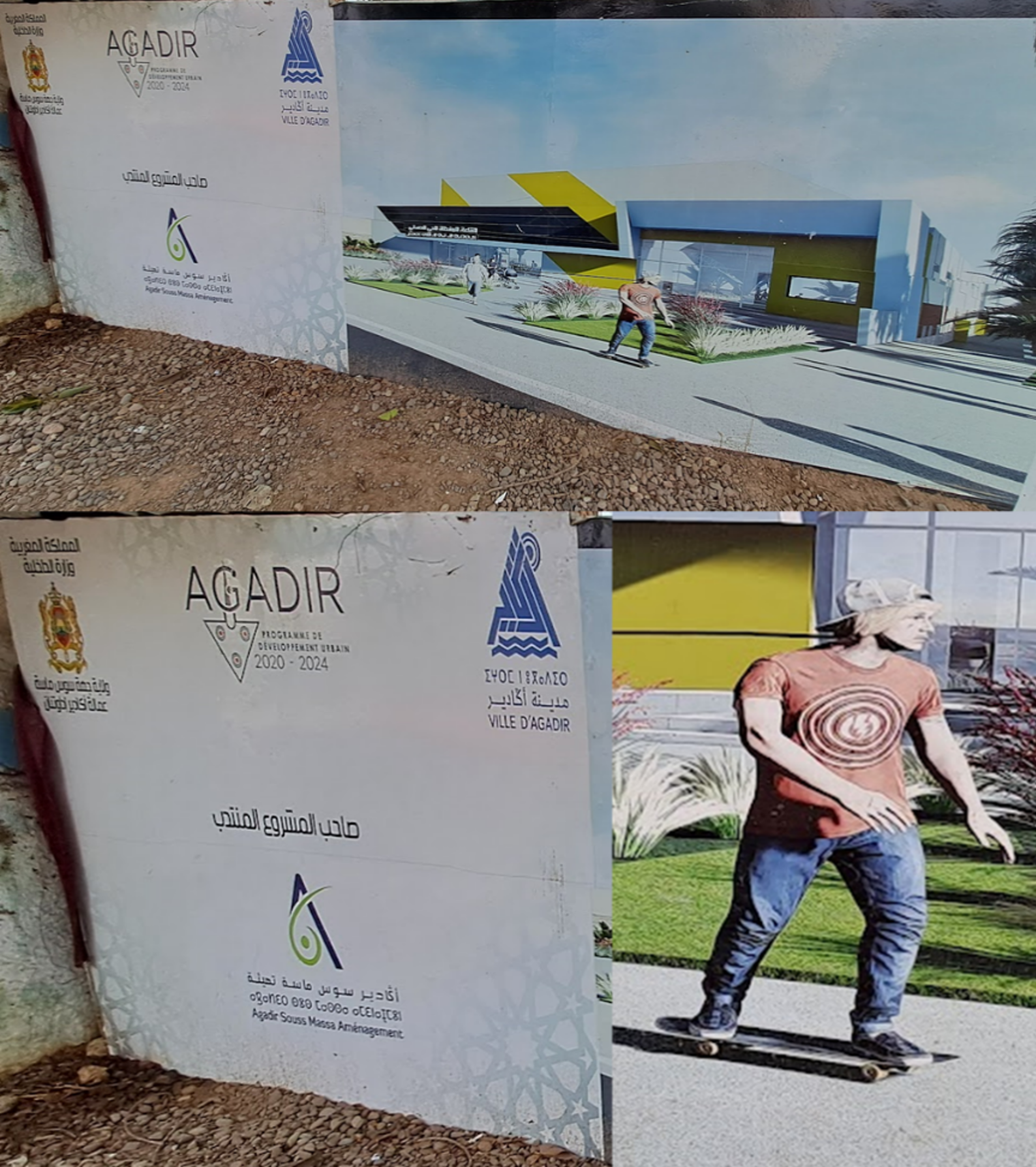
In this context, skateboarding infrastructures function not only as welfare provision but also as tools of territorial development linked to tourism, regional branding, and market-oriented growth. The trajectory of the Maghrib Skate community illustrates these dynamics. While members relocated to Douar Sahili for its skateboarding infrastructures, sustaining their lifestyle required engagement with the surrounding tourism economy. Entrepreneurship has become a central livelihood strategy, with members operating skateboarding- and tourism-related activities – including clothing brands, guiding services, and skate schools (Chenier, 2024). The Wheels & Lenses hostelexemplifies this shift, mobilizing the community’s skateboarding networks and subcultural capital (Dupont, 2014) to cater to visiting skateboarders. These developments illustrate how grassroots skate communities convert subcultural expertise into economic opportunities within neoliberal development contexts.
These dynamics reflect what Bergh (2016) terms Morocco’s model of “inclusive neoliberalism,” in which development policies prioritize decentralized initiatives and entrepreneurial activation over structural redistribution. Within this youth “activation” framework (Barsoum, 2018), young people are encouraged to transform subcultural practices into economic assets and pursue social mobility through discipline, adaptability, and entrepreneurship. This logic aligns youth subcultural and sports participation with broader neoliberal citizenship norms (Darnell & Hayhurst, 2011) and post-Fordist economies, where creativity, flexibility, and entrepreneurial initiative become markers of successful social integration (Chenier, 2024), and activities such as skateboarding are reframed as pathways to employability, innovation, and regional branding (Wheaton, 2004). At the same time, it normalizes precarious labor conditions and individualizes responsibility for social mobility. This governance model thus depoliticizes structural challenges such as social insecurity, unemployment, and spatial inequalities (Bergh, 2016; Turner, 2014).
These activation processes are closely linked to Positive Youth Development (PYD), a dominant framework within SDP (Schulenkorf et al., 2016). Market integration is at the core of PYD approaches, which frame social mobility as the outcome of individual initiative and skill development, thus relying on implicit deficit logics that portray Global South youth as lacking competencies that sports programs must cultivate (Coalter, 2010; Darnell, 2012). As Hartmann and Kwauk argue, such programs aim to “resocialize and recalibrate individual youth […] to maintain power and hierarchy, cultural hegemony, and the institutionalization of poverty and privilege” (2011, p. 8). In contexts such as Morocco, PYD risks reproducing Orientalist assumptions that local youth require external discipline, modernization, or moral correction. Moreover, employability and entrepreneurial training programs cannot guarantee social mobility in contexts where structural unemployment persists, and access to financial capital remains limited.
These reflections highlight how both national development policies and external SDP interventions contribute to broader processes of neoliberalization in Global South societies. At the same time, grassroots initiatives reveal more complex dynamics than top-down models suggest. Projects such as the Wheels & Lenses hostel demonstrate how local actors navigate these conditions by mobilizing cultural practices within existing economic structures.
Grassroots initiatives remain ambivalent as they may simultaneously challenge, adapt to, and reproduce neoliberal development logics. Therefore, the celebration of grassroots agency must be critically weighed against broader systemic factors, including unemployment, economic precarity, power relations, and global tourism economies that shape the realities of skateboarding and ‘development’.
Gender Dynamics
Throughout fieldwork, Moroccan skateboarders consistently identified female participation as a key issue – one that is also a dominant theme of SDP (Schulenkorf et al., 2016). In response to her experience as the only female skater in her hometown and her family’s initial reluctance, Rayssa founded Moroccan Skater Girls (pseudonym) in 2022. This informal collective promotes female participation through equipment provision, women-only events, and online safe spaces where members can “discuss the problems that girls face in society” (Rayssa, personal communication, 2023). By creating spaces of visibility, safety, and mutual support, the initiative challenges the perception of skateboarding as a male-only activity.
These barriers are both cultural and material. Morocco faces high youth unemployment (Haman, 2021; International Labour Organization, 2022), with women’s employment rates significantly lower than men’s (Rafiq, 2021). As Rayssa explains:
“Most girls skating they are not working, they’re still in school. […] After school boys can work and get paid, not girls. Girls just go home and stay with the family, they’re not allowed to go work at the age of 13 or 15.” (personal communication, 2023)
Limited income opportunities and stronger familial control over girls’ mobility directly affect their ability to purchase equipment, travel to skateparks, or participate regularly. Grassroots initiatives such as Moroccan Skater Girls thus address both symbolic exclusion and structural constraints.
These dynamics align with feminist leisure research showing that access to sport spaces is shaped by gendered power relations regulating women’s mobility, safety, and visibility (Aitchison, 1999, 2001). In Morocco, leisure practices are further mediated by norms of bodily respectability, family reputation, and public visibility (Guibert, 2018; Rubio-Rico et al., 2021). Lifestyle sports intensify these tensions through embodied public display and risk-taking (Wheaton, 2004). Studies of female surfers in Taghazout similarly highlight how participation entails negotiations of the male gaze, familial scrutiny, and moral judgements (Arab & Guibert, 2016). Moroccan female skaters are often accused of transgressing dominant gender expectations (Rayssa, personal communication, 2023), which resonates with global observations (Abulhawa, 2020; Atencio et al., 2009; Beal, 1996)
Tourism economies further complicate these dynamics. Feminist tourism scholarship shows how women’s presence in leisure spaces is often mobilized symbolically as markers of modernity, progress, or cultural difference (Pritchard, 2000). In Morocco, such representations intersect with Orientalist imaginaries that commodify gender and cultural difference for foreign audiences (Minca & Borghi, 2016). In Taghazout, the visibility of foreign women surfers and skateboarders can normalize female participation while simultaneously framing it through touristic spectacle, producing uneven gender geographies (Arab & Guibert, 2016).
Community-based governance can also shape gendered participation and access. While Maghrib Skate’s workshops are gender-mixed, Taghazout Skatepark Association appears to provide lessons and equipment exclusively to local boys. While many young males from Taghazout frequent the skatepark daily, local girls are largely absent from everyday practice. This contrasts with my observations across other Moroccan skateparks (including Agadir, Rabat, Casablanca, Tamsloht, and Taroudant), where female participation has at times approached half of users. Given that Taghazout Skatepark is the only site formally managed by an association, this governance structure may contribute to the exclusion of local girls. At the same time, the presence of foreign women and visiting Moroccan skaters highlights how tourism and spatial governance intersect to produce uneven gender access and visibility.
Such representational logics extend to SDP initiatives and media portrayals, which forefround female skaters as symbols of empowerment, emphasizing entrepreneurship and employability (e.g. Amell, 2022; Corrochano, 2023; Red Bull, 2023; Vogue Arabia, 2025). As Heinecken (2020) demonstrates, these narratives tend to individualize empowerment while obscuring structural inequalities, aligning with neoliberal development logics, where empowerment is depoliticized and framed through market participation (Thorpe & Chawansky, 2016; Thorpe et al., 2018).
Against this backdrop, these gender dynamics are not unique to Morocco. Skateboarding remains globally male-dominated (Atencio et al., 2009; Bäckström & Blackman, 2022; Beal, 1996; Thorpe, 2016; Yochim, 2010). Global North SDP actors often frame gender inequality in Global South contexts through Orientalist narratives portraying Muslim societies as resistant to gender progress (Said, 1978), while overlooking entrenched masculinities within skateboarding culture itself (Thorpe et al., 2018). Postcolonial feminist scholars warn that Global North-led gender interventions risk reproducing colonial assumptions by positioning Muslim women as passive subjects of empowerment rather than agents navigating complex local power relations (Abu-Lughod, 2002; Darnell, 2017; Rizwan & Ali, 2025; Samie, 2017; Thorpe & Chawansky, 2016; Toffoletti & Palmer, 2017). As Hayhurst et al. note, many SDP programs overlook local “religious, cultural, national, and international power relations […] or local girls and women’s own culturally specific forms of agency” (2021, p. 92). In contrast, grassroots initiatives such as Moroccan Skater Girlsoperate through culturally situated practices, suggesting that locally embedded actors are better positioned to navigate context-specific gender dynamics. These practices highlight how gender relations, like other dimensions of sport participation, are shaped through the intersection of local norms, global representations, and development discourses.
It is important to acknowledge the empirical limits of this analysis. Female participants represented a small proportion of interlocutors, limiting the ability to fully assess women’s skateboarding participation trajectories. Within this article, gender is therefore approached as one dimension of grassroots praxis, illustrating how local actors negotiate social norms while confronting the neoliberal and Orientalist framings embedded in mainstream SDP discourse.
DISCUSSION: RE-IMAGINE AND DECOLONISING SPORT FOR DEVELOPMENT THROUGH GRASSROOTS PRAXIS
This study examined grassroots skateboarding initiatives in Morocco to reflect on their implications for power relations and knowledge production within SDP research and practice. Rather than treating grassroots sport cultures as peripheral to development discourses, the Moroccan case illustrates how local communities generate their own forms of knowledge, organization, and social innovation. Examining these practices – often overlooked in mainstream SDP literature and programming – reveals the broader structural constraints shaping sport participation and development interventions.
Across the empirical sections, Moroccan skateboarders engage in diverse forms of grassroots experimentation addressing material constraints, spatial governance, institutional relations, and gender dynamics. Informal equipment circulation, community-run workshops, women-centered initiatives such as Moroccan Skater Girls, and collective negotiations over access to skate spaces demonstrate how local actors actively shape the conditions of sports participation. These practices show that outcomes commonly attributed to SDP programs – such as youth engagement, community building, and safe recreational spaces – are already being pursued through locally organized sporting cultures rather than externally designed interventions. In this sense, grassroots skateboarding initiatives embody culturally situated forms of agency emerging from lived experience.
These practices expose an important tension within the SDP field: while grassroots initiatives generate innovative responses to local challenges, their knowledge remains widely subjugated within dominant development frameworks. SDP research and practice have largely focused on formal organizations and externally funded programs, obscuring the everyday practices through which sport participation is sustained (Coalter, 2010; Darnell, 2012). As Darnell and Hayhurst (2011) argue, SDP knowledge systems tend to privilege Global North-led interventions while marginalizing local perspectives. By examining grassroots skateboarding communities, this study demonstrates that decentralized knowledge produced through informal sports cultures provides critical insight into how sport, development, and global power relations intersect. As Thorpe et al. note, such perspectives reveal “the unique forms of agency, creativity and resourcefulness being developed by local youth themselves” (2018, p. 371). Recognizing grassroots expertise thus challenges the hierarchical structures through which development expertise is typically produced and legitimized.
These dynamics are closely linked to broader postcolonial and Orientalist critiques of development discourse. As Said (1978) argues, Orientalism constructs non-Western societies as lacking modernity, organization, or progress, thereby legitimizing external intervention. Within SDP, similar narratives portray Global South communities as deficient in institutional capacity, infrastructure, or social cohesion (Darnell, 2017). These representations often take gendered and neoliberal forms, framing Muslim women as needing empowerment or youth as requiring “activation” through sport. They also draw on broader Orientalist tropes depicting Muslim societies as resistant to modernity or gender progress. Such perspectives frequently overlook structural inequalities within global skateboarding and sport cultures themselves, including entrenched masculinities shaping participation globally. The Moroccan case complicates these assumptions: rather than passive beneficiaries of development programs, local skateboarders actively shape their environments, negotiate institutional relationships, and develop alternative strategies for sustaining participation. These findings complement scholarship on “agency from below” (Hayhurst, 2009), highlighting how local actors creatively navigate and reshape development structures through everyday practice.
However, recognizing grassroots agency should not lead to romanticized interpretations of local autonomy, as these dynamics unfold within broader processes of neoliberalization (Darnell & Hayhurst, 2012). Morocco’s “inclusive neoliberalism” (Bergh, 2016) promotes entrepreneurial activation and decentralized initiative while leaving structural inequalities largely unaddressed. Grassroots skateboarding communities operate within these conditions, often converting subcultural practices into economic opportunities within tourism and market-oriented development contexts. As McSweeney et al. (2019) suggest, such engagement constitutes forms of “institutional work” through which local actors both navigate and reproduce existing development structures. In this sense, grassroots initiatives simultaneously contest and adapt to neoliberal governance, revealing the ambivalent nature of local agency.
Ultimately, the Moroccan case demonstrates that re-centering grassroots knowledge is essential for rethinking power relations within the SDP field. Prioritizing grassroots praxis is not only a matter of epistemic justice but also a strategic imperative for developing more context-sensitive and politically grounded approaches to sport-related development. Understanding sport’s role in social change thus requires moving beyond program-centered perspectives towards a sustained engagement with locally embedded practices and how they intersect with global development agendas.
CONCLUSION
This study examined grassroots skateboarding initiatives in Morocco to explore how locally embedded sport communities contribute to rethinking knowledge production and power relations within the SDP field. The findings show how grassroots actors generate context-specific forms of social innovation to navigate material constraints, spatial governance, institutional relations, and gender dynamics through locally situated practices.
By focusing on informal sporting cultures rather than formal or Global North-led development organizations, the study foregrounds grassroots knowledge and agency as central to understanding sport-based development processes. In doing so, it challenges dominant knowledge hierarchies within SDP that privilege institutional expertise and externally designed interventions. From a postcolonial perspective, these hierarchies are closely linked to Orientalist representations that shape how sport, development, and expertise are constructed and legitimized. The Moroccan case instead demonstrates how grassroots actors produce situated knowledge about sport, space, and social change, while articulating forms of development that do not necessarily align with hegemonic neoliberal agendas.
Several implications emerge for research and practice. For scholars, the findings underscore the importance of expanding analytical attention beyond formal SDP organizations to include grassroots sporting communities as key sites of knowledge production. For practitioners, they highlight the need to engage with existing local initiatives before introducing external programs, recognizing that grassroots actors possess critical contextual expertise.
The findings also suggest that transnational engagement in SDP does not necessarily require direct interventionism in local contexts. Many structural challenges affecting emerging skateboarding scenes – such as limited equipment distribution or global visibility – are embedded within global sport industries rather than local communities themselves. Addressing these constraints may therefore involve forms of support beyond interventionist programs, including domestic activism within the Global North aimed at transforming the global structures shaping sport participation. However, such efforts must be developed in close consultation with local actors, who should retain the authority to determine whether to integrate into global sport markets or pursue more autonomous alternative pathways.
Future research could extend this analysis by examining grassroots sport cultures in other contexts and further exploring how local communities negotiate relationships with global sport industries, development organizations, and state institutions.
DECLARATION OF CONFLICTING INTERESTS
The author declared no potential conflicts of interest with respect to the research, authorship and/or publication of this article.
FUNDING
The author disclosed receipt of the following financial support for the research, authorship, and/or publication of this article: This research received support from the project: What works? Youth Transition from Education to Employment in the Middle East and North Africa, funded by the Research Council of Finland, decision number 320449.
FOOTNOTES
1. The exact location and event titles are not disclosed to maintain participants’ confidentiality
2. No further information regarding these participants can be disclosed to ensure their anonymity and confidentiality towards the federation.
REFERENCES
Abulhawa, D. (2020). Skateboarding and femininity: Gender, space-making and expressive movement. Routledge.
Abulhawa, D. (2022). Participant-centred skateboarding in the West Bank, occupied Palestine: An analysis of the work of SkatePal. In J. Cherrington & J. Black (Eds.), Sport and physical activity in catastrophic environments (pp. 193-208). Routledge.
Abu‐Lughod, L. (2002). Do Muslim women really need saving? Anthropological reflections on cultural relativism and its others. American Anthropologist, 104(3), 783-790. https://doi.org/10.1525/aa.2002.104.3.783
Açıkgöz, S., Haudenhuyse, R., & Hacısoftaoğlu, İ. (2022). ‘There is nothing else to do!’: the impact of football-based sport for development programs in under-resourced areas. Sport in Society, 25(2), 281-298. https://doi.org/10.1080/17430437.2020.1778670
Adams, A., & Harris, K. (2014). Making sense of the lack of evidence discourse, power and knowledge in the field of sport for development. International Journal of Public Sector Management, 27(2), 140-151. https://doi.org/10.1108/ijpsm-06-2013-0082
Aitchison, C. (1999). New cultural geographies: The spatiality of leisure, gender and sexuality. Leisure Studies, 18(1), 19-39. https://doi.org/10.1080/026143699375032
Aitchison, C. (2001). Theorizing Other discourses of tourism, gender and culture: Can the subaltern speak (in tourism)? Tourist Studies, 1(2), 133-147. https://doi.org/10.1177/146879760100100202
Amara, M. (2025). Towards a plural Olympic studies agenda: Contesting Orientalism through Arab sport narratives. Asian Journal of Sport History & Culture, 4(3), 336-351. https://doi.org/10.1080/27690148.2025.2530592
Amell, C. (2022). Skate like a girl. Prestel.
Arab, C., & Guibert, C. (2016). Être surfeuse au Maroc. Les conditions d’une socialisation à contre-courant. Terrains et Travaux: Revue de Sciences Sociales, (1), 175-198. https://doi.org/10.3917/tt.028.0175
Association Temara Skateboard. (2017). Mamcharkinch “let’s make skateboarding great again” [Facebook photo]. Facebook. https://www.facebook.com/photo/?fbid=687453944771055&set=a.564604845708632
Atencio, M., Beal, B., & Wilson, C. (2009). The distinction of risk: Urban skateboarding, street habitus and the construction of hierarchical gender relations. Qualitative Research in Sport and Exercise, 1(1), 3-20. https://doi.org/10.1080/19398440802567907
Atkinson M. (2016). Ethnography. In Smith B., & Sparkes A. C. (Eds.), Routledge handbook of qualitative research in sport and exercise (pp. 71–83). Routledge.
Bäckström, Å., & Blackman, S. (2022). Skateboarding: From urban spaces to subcultural Olympians. Young, 30(2), 121-131. https://doi.org/10.1177/11033088221081944
Barsoum, G. (2018). Can youth activation policies be central to social policies in MENA countries? International Social Security Review, 71(2), 39-56. https://doi.org/10.1111/issr.12165
Batuev, M., & Robinson, L. (2017). How skateboarding made it to the Olympics: an institutional perspective. International Journal of Sport Management and Marketing, 17(4-6), 381-402. https://doi.org/10.1504/ijsmm.2017.087446
Beal, B. (1995). Disqualifying the official: An exploration of social resistance through the subculture of skateboarding. Sociology of Sport Journal, 12(3), 252-267. https://doi.org/10.1123/ssj.12.3.252
Beal, B. (1996). Alternative masculinity and its effects on gender relations in the subculture of skateboarding. Journal of Sport Behavior, 19(3), 204-220.
Benattou, M. (2021). Stratégie foncière et immobilière au Maroc, recomposition territoriale et rapport à la production du logement «abordable» Quelles perspectives pour Agadir? Espace Géographique et Société Marocaine, (45-46), 31-52. https://doi.org/10.34874/IMIST.PRSM/EGSM/25458
Benattou A. (2023). Taghazout Bay Station between tourist projection, lived experience and globalized margins: A socio-territorial communication approach. International Journal of the Researcher, 4(2), 1002–1023.
Bergh, S. I. (2016). ‘Inclusive’ neoliberalism, local governance reforms and the redeployment of state power: The case of the National Initiative for Human Development (INDH) in Morocco. In S. I. Bergh (Ed.), The redeployment of state power in the Southern Mediterranean (pp. 108-124). Routledge.
Berriane, M. (2021). La ville arabe à l’épreuve du tourisme. Hespéris-Tamuda, 56(4), 97-121.
Berriane, M., & Moizo, B. (2020). De la barque à la planche, de la planche au béton: changements et adaptations liés au tourisme à Taghazout (littoral Atlantique, Maroc). In C. Guibert. (Éd.), Les Mondes du surf: transformations historiques, trajectoires sociales, bifurcations technologiques, Bordeaux, MSHA, 213-235.
Bregman, S. (2024, May 14). Here are the athletes that will compete in park and street skateboarding at the Olympic Qualifier Series. https://www.olympics.com/en/news/here-are-the-athletes-that-will-compete-in-park-and-street-skateboarding-at-the-olympic-qualifier-series
Chenier, V. (2024). Reconciling work and skateboarding in Morocco: Exploring young people’s lifestyle entrepreneurship ventures. Young, 33(3), 221-238. https://doi.org/10.1177/11033088241307494
Cheer, J. (2020). Tourism and its discontents in the Global South. Current History, 119(813), 29-33. https://doi.org/10.1525/curh.2020.119.813.29
Coalter, F. (2008). Sport-in-development: Development for and through sport? In M. Nicholson & R. Hoye (Eds.), Sport and social capital (pp. 59-88). Routledge.
Coalter, F. (2010). The politics of sport-for-development: Limited focus programs and broad gauge problems? International Review for the Sociology of Sport, 45(3), 295-314. https://doi.org/10.1177/1012690210366791
Collison, H., Darnell, S. C., Giulianotti, R., & Howe, P. D. (Eds.). (2020). Routledge handbook of sport for development and peace (1st ed.). Routledge. https://doi.org/10.4324/9781315455174
Commune of Agadir. (2022). Agadir Communal Action Plan 2022–2027 (Final version, December 2022). https://www.opengovpartnership.org/wp-content/uploads/gravity_forms/24-6fb2e5a17f4b4b4e72048871008bb9f3/2025/05/Final-version-of-the-Communal-Action-Plan-2022-2027-1_compressed.pdf
Corrochano, D. (2023). Raised by sand and salty water [Film]. David Corrochano. https://davidcorrochano.com/project/raised-by-sand-and-salty-water/
Critchley, T. (2022). Skateboarding in Jamaica: Commoning a postcapitalist future. In J. Cherrington & J. Black (Eds.), Sport and physical activity in catastrophic environments (pp. 21-37). Routledge.
Critchley, T., & Novotný, J. (2024). Skateboarding in neoliberal Amman: Spatial politics, inclusivity and infrastructuring 7Hills Skatepark. In N. Bobic & F. Haghighi (Eds.), The Routledge handbook of architecture, urban space and politics, Volume II (pp. 359-376). Routledge.
Darnell, S. (2012). Sport for development and peace: A critical sociology (p. 192). Bloomsbury Academic.
Darnell, S. C. (2017). Orientalism through sport: towards a Said-ian analysis of imperialism and ‘Sport for Development and Peace’. In L. A. Wenner (Ed.), Sport, race and ethnicity (pp. 6-20). Routledge.
Darnell, S. C., Chawansky, M., Marchesseault, D., Holmes, M., & Hayhurst, L. (2018). The state of play: Critical sociological insights into recent ‘sport for development and peace’ research. International Review for the Sociology of Sport, 53(2), 133-151. https://doi.org/10.1177/1012690216646762
Darnell, S. C., & Hayhurst, L. M. (2011). Sport for decolonization: Exploring a new praxis of sport for development. Progress in Development Studies, 11(3), 183-196. https://doi.org/10.1177/146499341001100301
Darnell, S. C., & Hayhurst, L. (2012). Hegemony, postcolonialism and sport-for-development: A response to Lindsey and Grattan. International Journal of Sport Policy and Politics, 4(1), 111-124. https://doi.org/10.1080/19406940.2011.627363
Desmond, M. (2014). Relational ethnography. Theory and Society, 43(5), 547-579. https://doi.org/10.1007/s11186-014-9232-5
Dupont, T. (2014). From core to consumer: The informal hierarchy of the skateboard scene. Journal of Contemporary Ethnography, 43(5), 556-581. https://doi.org/10.1177/0891241613513033
El Akari, A. (2022). Autonomy of sport and the state intervention: Case of provisional sport committees in Morocco. The International Journal of Business Management and Technology, 6(1), 225–232.
Finlay, L. (2002). Negotiating the swamp: the opportunity and challenge of reflexivity in research practice. Qualitative Research, 2(2), 209-230. https://doi.org/10.1177/146879410200200205
Fédération Royale Marocaine des Sports Urbains. (n.d.). Événements. https://www.frmsumaroc.ma/category/evenement_frmsu/
Frost, F., & Singh, J. N. (2023). Breaking in Morocco: Opportunities and challenges for professionalization and gender equality in the run-up to the 2024 Olympic Games. Global Hip Hop Studies, 4(2), 91-107. https://doi.org/10.1386/ghhs_00093_1
Giulianotti, R. (2011). Sport, peacemaking and conflict resolution: A contextual analysis and modelling of the sport, development and peace sector. Ethnic and Racial Studies, 34(2), 207-228. https://doi.org/10.1080/01419870.2010.522245
Giulianotti, R., Coalter, F., Collison, H., & Darnell, S. C. (2019). Rethinking sportland: A new research agenda for the sport for development and peace sector. Journal of Sport and Social Issues, 43(6), 411-437. https://doi.org/10.1177/0193723519867590
Guibert, C. (2018). Social uses of the beach and relationships with transgressive bodies: Being a female surfer in Morocco. In lisahunter (Ed.), Surfing, sex, genders and sexualities (pp. 110-128). Routledge.
Haman, O. B. (2021). The reality of youth unemployment and unsuitable development models in the Global South: Evidence from Morocco. International Journal of African Renaissance Studies, 16(1), 149–164. https://doi.org/10.1080/18186874.2021.1950559
Hartmann, D., & Kwauk, C. (2011). Sport and development: An overview, critique, and reconstruction. Journal of Sport and Social Issues, 35(3), 284-305. https://doi.org/10.1177/0193723511416986
Hayhurst, L. M. (2009). The power to shape policy: Charting sport for development and peace policy discourses. International Journal of Sport Policy and Politics, 1(2), 203-227. https://doi.org/10.1080/19406940902950739
Hayhurst, L. M., Thorpe, H., & Chawansky, M. (2021). Action sports for gender development. In L. M. Hayhurst, H. Thorpe, & M. Chawansky (Eds.), Sport, Gender and Development: Intersections, Innovations and Future Trajectories (pp. 87-113). Emerald Publishing Limited.
Heinecken, D. (2021). The heart of the game: Girls, sports and the limits of “Empowerment”. Journal of Sport and Social Issues, 45(3), 251-271. https://doi.org/10.1177/0193723519898705
International Labour Organization. (2022). Global employment trends for youth 2020: Arab States. https://www.ilo.org/global/about-the-ilo/WCMS_853324/lang–en/index.htm
Khokhryakova, O., & Svensson, P. G. (2026). Understanding how local contexts shape partnerships in sport for development across Latin America. Sport Management Review, 29(1), 159-188. https://doi.org/10.1080/14413523.2025.2550088
Kidd, B. (2008). A new social movement: Sport for development and peace. Sport in Society, 11(4), 370-380. https://doi.org/10.1080/17430430802019268
King Mohammed VI. (2005, May 18). Discours Royal institutionnel du 18 mai 2005 [Royal speech]. Initiative Nationale pour le Développement Humain. https://indh-tangerassilah.ma/discours-royal-institutionnel-du-18-mai-2005/
Lindsey, I., & Bitugu, B. B. (2018). Partnerships in and around SDP. In H. Collison, S. C. Darnell, R. Giulianotti, & P. D Howe (Eds.), Routledge handbook of sport for development and peace (pp. 80–90). Routledge.
Low, S., & Smith, N. (Eds.). (2013). The politics of public space. Routledge.
Lyras, A., & Welty Peachey, J. (2011). Integrating sport-for-development theory and praxis. Sport Management Review, 14(4), 311-326. https://doi.org/10.1016/j.smr.2011.05.006
Massey, W. V., & Whitley, M. A. (2018). SDP and research methods. In H. Collison, S. C. Darnell, R. Giulianotti, & P. D Howe (Eds). Routledge handbook of sport for development and peace (pp. 175-184). Routledge.
McSweeney, M., Kikulis, L., Thibault, L., Hayhurst, L., & van Ingen, C. (2019). Maintaining and disrupting global-North hegemony/global-South dependence in a local African sport for development organisation: The role of institutional work. International Journal of Sport Policy and Politics, 11(3), 521-537. https://doi.org/10.1080/19406940.2018.1550797
Minca, C., & Borghi, R. (2016). Morocco: Restaging colonialism for the masses. In P. O. Pons & M. Crang (Eds.), Cultures of mass tourism (pp. 21-52). Routledge.
Ministère de l’Économie et des Finances, Royaume du Maroc. (2024). Loi de finances n° 60-24 pour l’année budgétaire 2025. Bulletin Officiel du Royaume du Maroc, Cent-dixième année – N° 6944 : Loi de finances (Chapitre 44). Secrétariat général du Gouvernement, Royaume du Maroc.
Mitchell, D. (2003). The right to the city: Social justice and the fight for public space. Guilford Press.
Narayan, K. (1993). How native is a “native” anthropologist? American Anthropologist, 95(3), 671–686. https://doi.org/10.1525/aa.1993.95.3.02a00070
Nicholls, S., Giles, A. R., & Sethna, C. (2011). Perpetuating the ‘lack of evidence’ discourse in sport for development: Privileged voices, unheard stories and subjugated knowledge. International Review for the Sociology of Sport, 46(3), 249-264. https://doi.org/10.1177/1012690210378273
O’Donohoe, S. (2010). Netnography: Doing ethnographic research online. International Journal of Advertising, 29(2), 328-330. https://doi.org/10.2501/s026504871020118x
Rafiq, M. (2021). Activités génératrices de revenus: quelles retombées sur la pauvreté des femmes au Maroc? Revue d’Etudes en Management et Finance d’Organization, 6(1).
Red Bull. (2023). Wafa Heboul: Skateboard interview. The Red Bulletin. https://www.redbull.com/fr-fr/theredbulletin/wafa-heboul-skateboard-interview
Riger, S., & Sigurvinsdottir, R. (2016). Thematic analysis. In L. A. Jason & D. S. Glenwick (Eds.), Handbook of methodological approaches to community-based research: qualitative, quantitative, and mixed methods (pp. 33-41). Oxford University Press.
Rizwan, N., & Ali, A. E. (2025). Muslimness, women, and sport. In M. Yanity & D. S. Coombs (Eds.) Media, communication and the 2023 FIFA women’s world cup (pp. 246-263). Routledge.
Rogerson, C. M., & Rogerson, J. M. (2021). The other half of urban tourism: Research directions in the Global South. In C. M. Rogerson & J. M. Rogers (Eds.), Urban tourism in the global south: South African perspectives (pp. 1-37). Springer.
Rubio‐Rico, L., de Molina‐Fernández, I., Font‐Jiménez, I., & Roca‐Biosca, A. (2021). Meanings and practices of the physical activity engaged in by Moroccan women in an Islamic urban environment: A quasi‐ethnography. Nursing Open, 8(5), 2801-2812. https://doi.org/10.1002/nop2.857
Saavedra, M. (2018). SDP and postcolonial theory. In H. Collison, S. C. Darnell, R. Giulianotti, & P. D. Howe (Eds.), Routledge handbook of sport for development and peace (pp. 208-217). Routledge.
Sadki, A. (2022). Appropriation of space and neighborhood conflicts in the context of tourist gentrification: The case of the Medina of Marrakech (Morocco) [Doctoral dissertation, University of Montreal]. http://www.abhatoo.net.ma/maalama-textuelle/developpement-economique-et-social/developpement-economique/tourisme/tourisme-generalites/appropriation-de-l-espace-et-conflits-de-voisinage-en-contexte-de-gentrification-touristique-cas-de-la-medina-de-marrakech-maroc
Said, E. W. (1978). Orientalism. Pantheon Books
Samie, S. F. (2017). De/colonising ‘sporting Muslim women’: Post-colonial feminist reflections on the dominant portrayal of sporting Muslim women in academic research, public forums and mediated representations. In A. Ratna & S. F. Samie (Eds.), Race, gender and sport (pp. 35-62). Routledge.
Schulenkorf, N., Sherry, E., & Rowe, K. (2016). Sport-for-development: An integrated literature review. Journal of Sport Management, 30(1), 22–39. https://doi.org/10.1123/jsm.2014-0263
Schulenkorf, N., Welty Peachey, J., Spaaij, R., & Collison-Randall, H. (Eds.). (2024). Handbook of sport and international development. Edward Elgar Publishing. https://www.e-elgar.com/shop/gbp/handbook-of-sport-and-international-development-9781800378919.html
Skateistan. (2025). Locations. https://skateistan.org/locations/all
Svensson, P. G., & Woods, H. (2017). A systematic overview of sport for development and peace organizations. Journal of Sport for Development, 5(9), 36-48. https://jsfd.org/2017/09/20/a-systematic-overview-of-sport-for-development-and-peace-organisations/
Tillmann-Healy, L. M. (2003). Friendship as method. Qualitative Inquiry, 9(5), 729-749. https://doi.org/10.1177/1077800403254894
Thorpe, H. (2016). Action sports for youth development: Critical insights for the SDP community. International Journal of Sport Policy and Politics, 8(1), 91-116. https://doi.org/10.1080/19406940.2014.925952
Thorpe, H., Ahmad, N., & Williams, N. (2018). SDP and action sports. In H. Collison, S. C. Darnell, R. Giulianotti, & P. D. Howe (Eds.), Routledge handbook of sport for development and peace (pp. 363-373). Routledge.
Thorpe, H., & Chawansky, M. (2016). The ‘girl effect’ in action sports for development: The case of the female practitioners of Skateistan. In H. Thorpe & R. Olive (Eds.), Women in action sport cultures: Identity, politics and experience (pp. 133-152). Palgrave Macmillan.
Toffoletti, K., & Palmer, C. (2017). New approaches for studies of Muslim women and sport. International Review for the Sociology of Sport, 52(2), 146-163. https://doi.org/10.1177/1012690215589326
Turner, J. (2014). Being young in the age of globalization: A look at recent literature on neoliberalism’s effects on youth. Social Justice, 41(4 (138), 8-22. https://www.jstor.org/stable/24871272
Vogue Arabia. (2025, May 7). Resilience on wheels: Meet the fearless females shaping Morocco’s skating scene. Vogue Arabia. https://www.voguearabia.com/article/fearless-women-skaters-shaping-moroccos-skate-scene
Wacquant, L. (2006). Body and soul: Notebooks of an apprentice boxer. Oxford University Press.
Wang, Y., & Tziamalis, A. (2023). International tourism and income inequality: The role of economic and financial development. Tourism Economics, 29(7), 1836-1864. https://doi.org/10.1177/13548166231177106
Wheaton B. (2004). Understanding lifestyle sport: Consumption, identity and difference. Routledge.
Whitley, M. A., Massey, W. V., Camiré, M., Blom, L. C., Chawansky, M., Forde, S., & Darnell, S. C. (2019). A systematic review of sport for development interventions across six global cities. Sport Management Review, 22(2), 181-193. https://doi.org/10.1016/j.smr.2018.06.013
Yochim, E. C. (2010). Skate life: Re-imagining white masculinity. University of Michigan Press.

